With more than 30 years of telecommunications and hyperscale infrastructure experience, Jaideep Kataria will help SQUAN build on its established fiber and infrastructure capabilities to address emerging needs across the data center ecosystem.

Hyperscale data center growth is accelerating the demand for the infrastructure required to support it.

More facilities mean more than additional computing capacity. They require power, fiber, long-haul connectivity, site infrastructure and the physical networks connecting facilities to one another and to the broader communications ecosystem.

That infrastructure must keep pace with a market moving increasingly fast.

That is where Jaideep saw an opportunity for SQUAN.

Jaideep has joined SQUAN as Chief Technology Officer, Data Center Services, bringing more than 30 years of experience leading network infrastructure initiatives across international telecommunications and hyperscale environments. But his perspective on SQUAN’s opportunity began before he joined the company.

“Before I came to SQUAN, one of the things I already knew about the company was its ability to build fiber infrastructure,” Jaideep said. “That stood out because hyperscalers are working to get more fiber miles built and routes constructed as quickly as possible. The market is moving incredibly fast.”

For SQUAN, that intersection between increasing infrastructure demand and capabilities the company has spent years building creates a natural starting point for its Data Center Services organization.

A Construction Problem, Not Just a Demand Problem

Much of the conversation surrounding data centers begins with demand.

AI, cloud computing and continued growth in data consumption are driving the need for greater computing capacity. Behind that growth, however, is an equally important physical infrastructure challenge.

Capacity has to be connected.

Fiber routes have to be engineered and constructed. Power has to reach the site. Long-haul networks have to connect facilities across increasingly large footprints. Supporting infrastructure has to be built, installed and ultimately turned over ready for operation.

And as hyperscalers move faster, the resources required to execute that work do not automatically expand at the same pace.

Jaideep identified that gap as one of the opportunities for SQUAN.

“It’s not that hyperscalers don’t value the providers they already have,” Jaideep said. “The challenge is the pace and scale of what they’re trying to build. There are only so many resources available, and that creates an opportunity for additional partners who can help bridge the gap.”

SQUAN’s experience engineering and constructing fiber infrastructure provides one entry point into that challenge. But the opportunity extends beyond the fiber routes itself.

Infrastructure Beyond the Data Center

When Jaideep talks about data centers, he does not view them as isolated buildings.

He describes them as infrastructure supporting the digital services people use every day, from artificial intelligence and streaming to banking, cloud applications and communications.

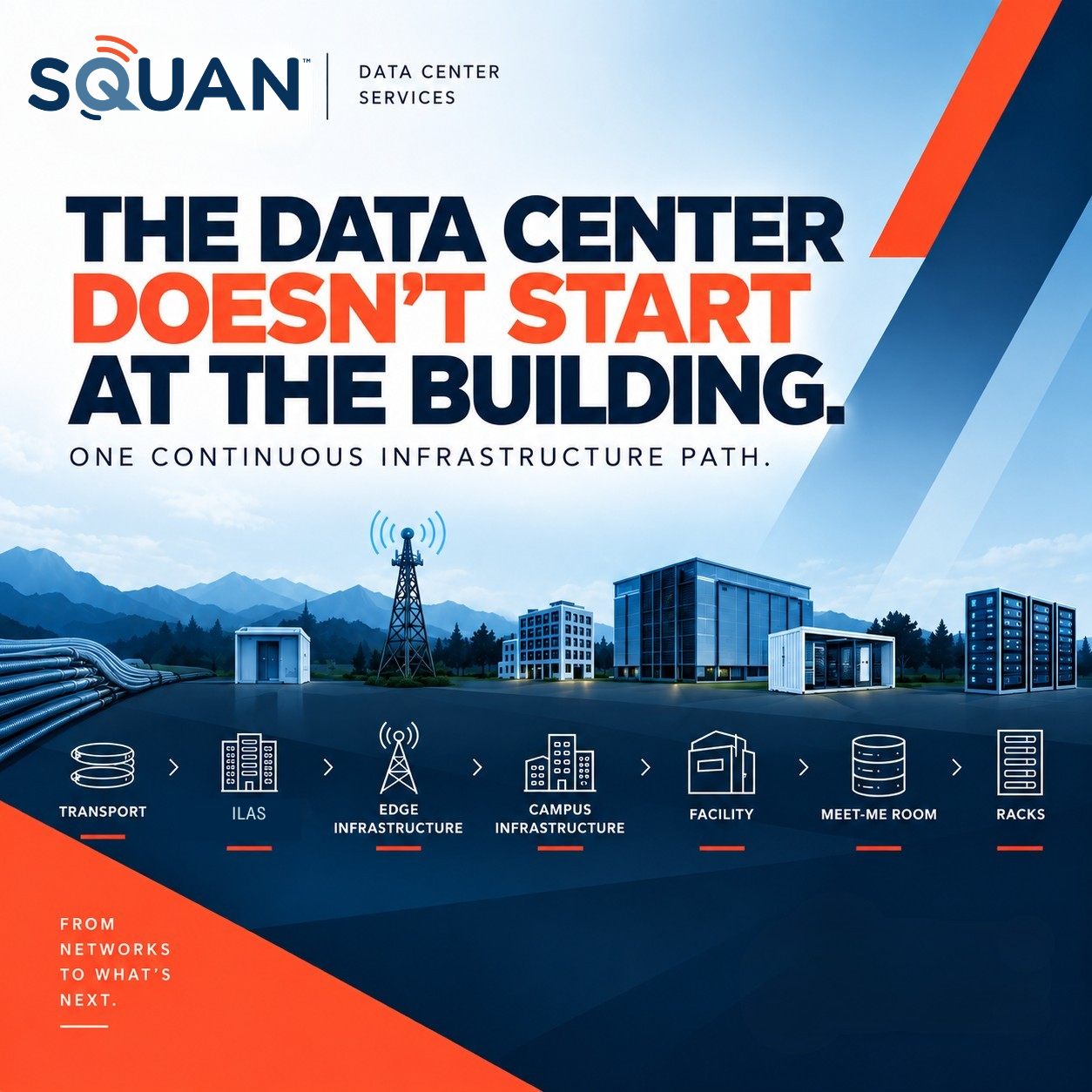
Those facilities depend on an ecosystem extending far beyond their walls.

Long-haul and middle-mile fiber connect facilities across markets. Intermediate infrastructure such as inline amplification sites, or ILAs, helps carry signals across those routes. Outside plant infrastructure eventually must connect with equipment and fiber inside the facility.

Each piece contributes to whether the larger network can operate as intended.

That creates an opportunity to think differently about where infrastructure work begins and ends.

Connecting Outside and Inside Infrastructure

SQUAN’s established fiber construction capabilities provide a foundation outside the facility. Data Center Services creates an opportunity to build from that foundation into adjacent infrastructure needs.

A key early focus area is ILAs — amplification sites placed along long-haul fiber routes to sustain signal strength over long distances.

Jaideep sees opportunities for SQUAN to support multiple elements surrounding those sites, from land and site development through construction, shelter placement, inside plant work- racking and stacking, fiber termination and power runs.

There are also opportunities to provide professional services inside existing facilities where the site and shelter infrastructure are already in place.

The significance is not simply the addition of another service.

It is an opportunity to create greater continuity between infrastructure outside the facility and the work required inside it.

For customers operating in an environment where available resources and speed of execution matter, reducing unnecessary separation between those workstreams can become increasingly valuable.

Building From What SQUAN Already Knows

That distinction is important to how SQUAN is approaching Data Center Services.

The strategy is not to enter the market, claiming to build every component of a hyperscale data center.

It is to identify where capabilities SQUAN has already developed across engineering, fiber construction, connectivity, power and critical infrastructure can solve real problems within the data center ecosystem, establish a track record there and expand deliberately.

Jaideep’s experience helps guide that progression.

After more than three decades working across telecommunications and network infrastructure, his perspective brings an understanding of both what hyperscalers are trying to accomplish and where infrastructure constraints can prevent those plans from becoming operational networks.

It also reinforces something increasingly important about the data center market: no single component of the infrastructure exists in isolation.

Power affects where facilities can be developed. Fiber determines how they connect. Long-haul networks determine how information moves between markets. Inside plant infrastructure determines how those connections ultimately reach the equipment they are designed to support.

Understanding those dependencies becomes increasingly important as the scale and speed of development increase.

The Next Chapter of SQUAN Data Center Services

Jaideep’s addition strengthens SQUAN’s ability to build its Data Center Services organization around those emerging infrastructure needs.

The opportunity begins with areas where SQUAN’s existing experience translates naturally, including fiber construction, long-haul infrastructure, ILAs and related inside plant services.

From there, the focus is on building credibility through execution and identifying where SQUAN can solve more of the infrastructure challenges connecting increasingly complex digital environments.

For Jaideep, that is ultimately what made the opportunity compelling.

Data centers may be the visible center of today’s digital infrastructure investment, but their ability to operate at scale depends on everything required to connect them.

That infrastructure is where SQUAN’s experience and its next opportunity increasingly intersect.

Learn more about SQUAN Data Center Services.

For the better part of two years, the broadband industry has been consumed by a single question: how much funding would arrive, and how fast. That question has been answered. The Broadband Equity, Access, and Deployment program has moved billions of dollars into state programs, and the debate over whether the money would come has given way to something more consequential.

The industry hasn’t fully reckoned with what that money requires.

BEAD is not simply a larger version of the broadband construction the industry has done for decades. It is a change in operating conditions. States are now managing deployments that span entire regions, involve dozens of concurrent workstreams, and carry federal reporting and compliance obligations tied directly to funding disbursement. The scale is new. The obligations are new. The margin for disorganization is smaller than it has ever been.

Most of the public conversation still treats this as a construction problem: enough contractors, enough crews, enough materials. That framing misses what is actually changing.

Funding Solved One Problem, it Created Another:

For years, the constraint on broadband expansion was capital. Providers and states knew where the gaps were. What they lacked was the funding to close them. BEAD removed that constraint, and removing it exposed a different one.

Capital does not deliver infrastructure. Operations do. And the operational demands of a statewide, federally funded deployment are structurally different from the demands of a regional buildout funded and managed by a single provider.

A traditional broadband project has a defined footprint, a single set of stakeholders, and a manageable number of moving parts. A BEAD-funded state deployment has multiple prime contractors, subcontractors operating across counties, permitting processes that vary by jurisdiction, inspection and compliance requirements tied to federal milestones, and a state broadband office that needs continuous, accurate visibility into progress to remain accountable to its own funding source.

None of that is a labor shortage. It is a coordination problem, and coordination problems do not resolve themselves just because more people show up to do the work.

Why Scale Changes the Operating Model, Not Just the Size:

It is tempting to think of BEAD deployments as bigger projects requiring more resources. That understates what is happening.

When a deployment grows from a single market to dozens of markets running simultaneously, the nature of the work changes. Engineering has to stay ahead of construction across every market at once, not just one. Permitting timelines vary by jurisdiction, and a delay in one county cannot be allowed to quietly cascade into a milestone risk for the entire state program. Inspections, restoration, and customer communication all have to happen consistently, regardless of which crew, which subcontractor, or which region is doing the work.

This is where the assumption that “more contractors” solves the problem starts to break down. Capable regional and local contractors remain essential to this work. Their expertise in local terrain, permitting relationships, and construction execution is not replaceable, and nothing about BEAD changes that. What changes is the coordination layer sitting above that work. Someone has to ensure that dozens of independently capable teams are moving on a shared timeline, reporting consistently, and not creating blind spots that only become visible once a milestone deadline is already at risk.

That coordination layer is the part of the operating model most delivery structures were never built to handle, because most of them were designed for single-market execution, not statewide orchestration.

Operational Coordination Is Becoming the Real Differentiator:

If capital was the constraint of the last two years, coordination is the constraint of the next several. The organizations that succeed at BEAD-scale deployment will not be distinguished primarily by their construction capability. Construction capability is table stakes. They will be distinguished by how well they manage the interaction between engineering, construction, compliance, and reporting as a single connected system rather than as separate functions that happen to touch the same project.

Consider what that actually requires in practice. Engineering has to be sequenced closely enough with construction that crews are never waiting on incomplete designs, and designs are never running so far ahead that field conditions have shifted by the time construction catches up. Compliance and reporting cannot be an end-of-month exercise; they have to reflect what is actually happening in the field in near real time, because state broadband offices are themselves accountable to federal milestones and cannot afford to discover a problem after it has already caused a delay. Customer communication has to be consistent across every market, because a customer’s experience with a restoration crew in one county shapes their expectations for a construction crew in another.

Handled well, this coordination becomes largely invisible. Handled poorly, it produces the pattern that will define which programs succeed over the next several years: individual workstreams that each look reasonably on track in isolation, while the program as a whole quietly falls behind, because no one had a clear enough view across all of it to see the problem forming.

Why Visibility Has Become a Prerequisite for Execution, Not an Add-On:

This is the point where most conversations about broadband delivery jump straight to software. That jump skips the more important question, which is why visibility has become operationally necessary in the first place.

At single-market scale, a program manager can reasonably hold the state of a project in their head, or reconstruct it through a handful of phone calls. At the scale BEAD introduces, that is no longer true. There are simply too many markets, too many permitting timelines, and too many interdependent workstreams for informal tracking to catch problems before they become delays.

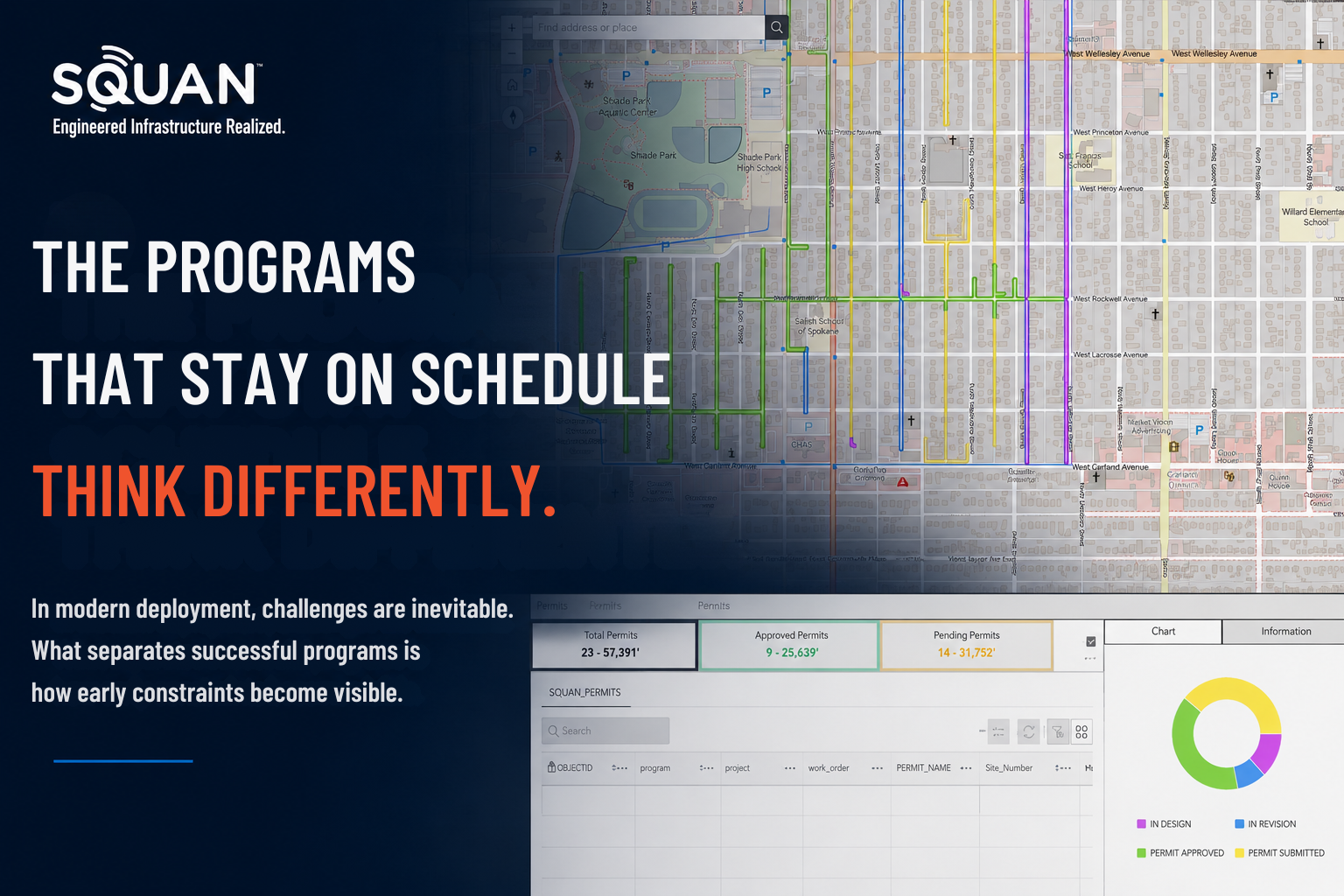
What changes the outcome is knowing, at any given point, where permits are stuck, which markets are ahead of schedule and which are falling behind, where a resource shift would prevent a milestone slip before it happens, and how progress is being documented in a form that satisfies funding requirements without a separate reporting effort bolted on at the end.

That is a different kind of visibility than a status report. A status report tells you what happened last week. Operational visibility tells you where to act this week, before a permitting delay in one county becomes a milestone problem for an entire state program. It is the difference between managing a program and monitoring one.

This is the operating principle behind VECTOR, the platform SQUAN uses to give engineering, construction, and program teams a shared, real-time view across a deployment. It was not built as a reporting tool. It exists because at BEAD scale, the organizations that can see across a program clearly enough to act early are the ones that hit their milestones, and the ones that cannot are the ones that discover problems only after they have already cost time.

Turnkey as the Conclusion, Not the Starting Point:

Turnkey delivery has often been discussed as a convenience: one vendor instead of several, one contract instead of many. At BEAD scale, that framing understates what an integrated delivery model actually provides.

The value of an integrated model is not that one organization touches every phase of the work. It is that engineering, construction, compliance, and reporting function as a single coordinated system rather than as disconnected vendors the customer has to manage and reconcile themselves. When those functions operate independently, the coordination burden does not disappear. It shifts onto the state broadband office or the provider, who now has to be the one holding the full picture together across contractors who each have visibility into only their own piece of the work.

An integrated delivery model does not eliminate the need for skilled local and regional contractors. It creates the operational structure within which that expertise can be deployed consistently across an entire state program, without the customer absorbing the coordination risk themselves.

That is a meaningfully different value proposition than “we do everything.” It is closer to: someone is accountable for the whole picture, so you do not have to be.

What Infrastructure Leaders Should Be Preparing For:

The next few years of broadband deployment will not be defined by whether funding arrives. It has arrived, and the timelines attached to it are already running. They will be defined by which organizations built, or partnered into, an operating model capable of managing execution at a scale the industry has not previously had to sustain.

That has several practical implications for the leaders managing these programs. Engineering and construction need to function as one connected workstream, not two functions that hand off to each other and hope nothing was lost in translation. Reporting needs to be built into the operating rhythm of the program, not treated as a compliance task performed after the fact. Mobilization into new markets needs to happen without rebuilding operational processes from scratch each time, because the timeline does not allow for it. And someone, whether internal or a delivery partner, needs a clear enough view across the entire program to catch a problem while it is still a permitting delay, not after it has become a missed milestone.

BEAD changed how much broadband work is happening. It also changed what it takes to deliver that work successfully. The organizations that recognize this early, and build the operational discipline to match it, will be the ones whose programs are still on schedule when the rest of the industry is explaining what went wrong.


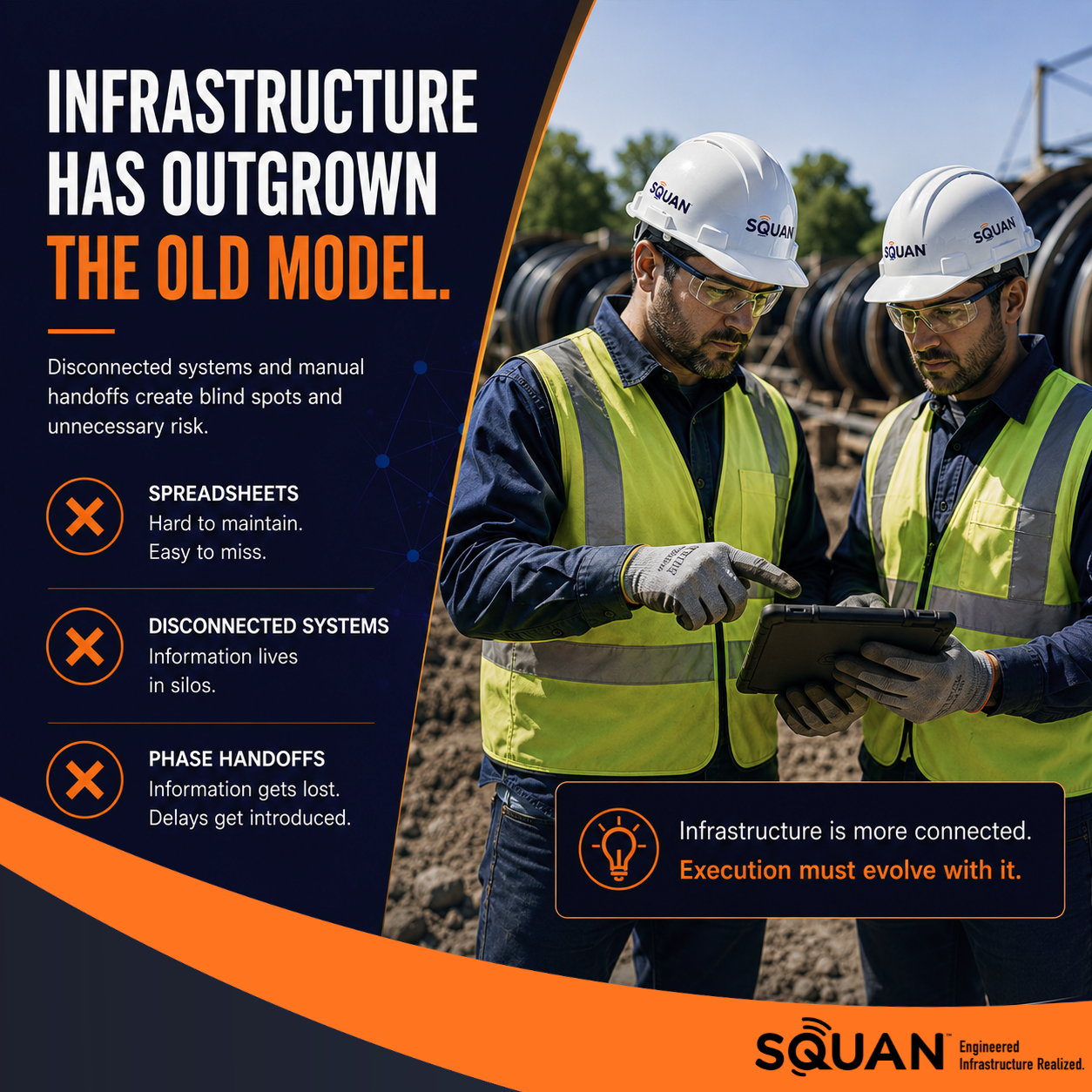
Why Deployment Operations Are Moving Beyond Spreadsheets, Status Reports, and Phase-Based Handoffs

Infrastructure deployment has become significantly more complex over the last decade.

Projects now span larger geographic footprints, involve more stakeholders, and require greater coordination between engineering, permitting, construction, restoration, and closeout activities. As programs continue to scale, the relationships between these workstreams have become just as important as the work itself. What happens in one area of a deployment can influence outcomes across multiple teams, often long before those impacts become visible through traditional reporting channels.

Despite this shift, many organizations continue to manage deployment operations using processes that were developed for a much different environment.

Spreadsheets, static reports, departmental updates, and phase-based handoffs have long served as the foundation of project management. For years, these approaches were sufficient because projects moved at a pace where information could be collected, communicated, and acted upon without creating significant operational risk.

Today’s deployment environment demands something different.

Complexity Has Changed the Equation

Most deployment challenges are no longer isolated events contained within a single workstream.

A permitting delay can influence construction sequencing. A field condition can require design modifications. A schedule adjustment can affect resource planning across multiple markets and crews. As programs become larger and more interconnected, the ripple effects of seemingly minor issues become increasingly difficult to predict and manage.

Organizations are no longer being asked to oversee individual activities alone. They are being asked to manage the relationships and dependencies that exist between those activities.

This is where many traditional operating models begin to show their limitations.

Engineering teams often manage one set of information, permitting teams manage another, and construction teams operate from their own schedules and updates. While each group may have visibility into its specific responsibilities, maintaining a clear understanding of how those responsibilities influence the broader program becomes much more challenging.

The problem is rarely a lack of information.

The problem is understanding how information from one workstream affects decisions, priorities, and outcomes across the rest of the deployment.

The Hidden Cost of Disconnected Execution

Disconnected systems create more than administrative inefficiencies. They create operational blind spots.

Information may exist somewhere within the organization, but if it is not visible to the right people at the right time, its value becomes significantly diminished. Teams can unknowingly make decisions based on outdated assumptions, emerging risks can go unnoticed, and critical dependencies may not become apparent until they begin affecting schedules, budgets, or resource allocation.

As deployment programs grow, these gaps in awareness become increasingly expensive.

The challenge is not that organizations are collecting too little information. In many cases, they are collecting more information than ever before. The challenge is that information often remains fragmented across multiple systems, teams, and reporting processes, making it difficult to understand how individual updates influence the broader program.

Readiness Is No Longer a Departmental Metric

Historically, project readiness was often measured through the progress of individual departments.

Engineering was complete. Permits were approved. Construction was prepared to mobilize.

The assumption was that if each workstream was progressing according to plan, the project itself was progressing according to plan.

Today’s deployment environment requires a more connected perspective.

Project readiness is increasingly determined by how well workstreams align with one another. A project may appear ready from one viewpoint while hidden constraints continue developing elsewhere. Permits may still be pending, field conditions may have changed, or construction sequencing may no longer reflect current realities.

Understanding readiness now requires visibility beyond individual tasks and milestones. It requires an understanding of how engineering, permitting, construction, restoration, and closeout activities collectively influence delivery.

The question is no longer whether information exists.

The question is whether organizations can understand what that information means for the broader program.

A Different Approach to Deployment Operations

As infrastructure programs continue to scale, organizations are beginning to rethink how operational visibility is created and maintained.

The focus is shifting away from simply collecting information and toward creating a more connected understanding of project execution. Rather than relying solely on periodic reports or departmental updates, leading organizations are seeking ways to maintain awareness across the entire deployment lifecycle.

The objective is not simply better reporting.

The objective is creating the awareness needed to identify risks earlier, make more informed decisions, and maintain schedule confidence as complexity increases.

Because infrastructure itself has become more connected than ever before.

The way organizations manage execution must evolve alongside it.

To explore this concept further, download our cornerstone guide:

When You Can’t See All the Pieces, You Can’t Put It All Together: How Fragmented Visibility Is Slowing Network Deployments and What It Takes to Regain Control


Why Operational Awareness Is Becoming a Competitive Advantage in Deployment

Deployment challenges are not new.

Permit delays happen. Field conditions change. Construction sequencing shifts. Unexpected constraints emerge. Every infrastructure program will encounter obstacles throughout the course of execution.

The difference between programs that maintain momentum and those that struggle to recover is often not the presence of challenges themselves.

It is how quickly those challenges become visible.

For many organizations, visibility still operates on a reporting cadence. Information is collected, consolidated, reviewed, and communicated through scheduled meetings, project updates, and status reports. While those processes have long been standard practice, they were developed for an operating environment that moved much slower than the one many deployment organizations face today.

As programs continue to grow in scale, waiting for the next report or the next status call can create a costly gap between operational reality and organizational awareness.

Challenges Become More Expensive Over Time

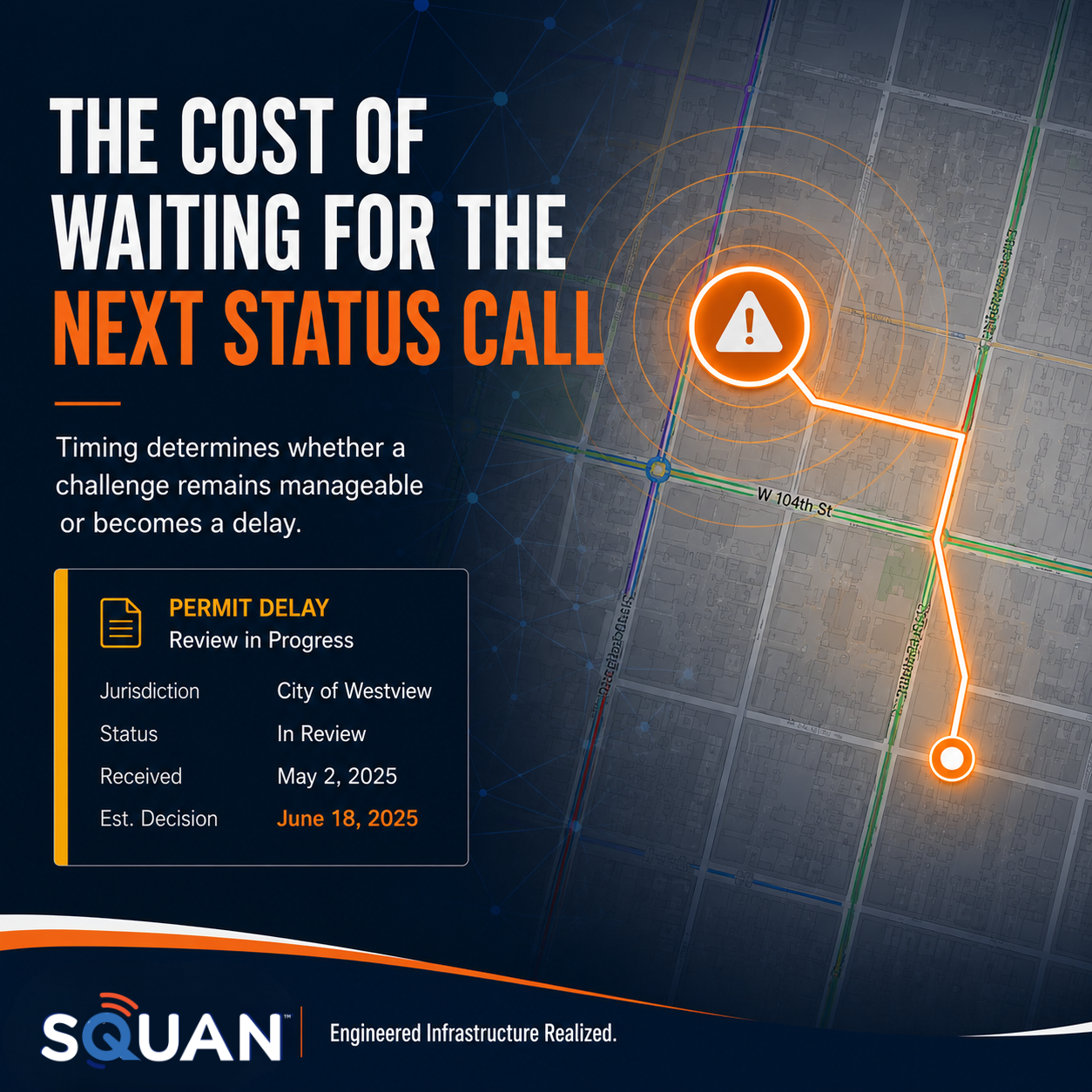
A permit delay identified weeks before construction begins is usually manageable.

Project teams have time to adjust sequencing, shift resources, modify schedules, and coordinate alternative paths forward. The challenge exists, but so do the options available to address it.

The same permit delay discovered only days before mobilization creates a very different situation.

Crews may already be scheduled. Materials may already be allocated. Construction plans may already be dependent on activities that can no longer move forward as expected.

The challenge itself has not changed.

The number of available responses has.

This principle extends well beyond permitting. Field conditions, restoration issues, design changes, material availability, and construction dependencies all follow a similar pattern. The longer a developing issue remains unseen, the fewer options organizations typically have to respond effectively.

Visibility Is No Longer a Reporting Function

Historically, deployment visibility was often viewed as a reporting function.

Organizations focused on understanding what had already happened, measuring progress against schedules, and communicating status to stakeholders.

Today’s deployment environment requires something different.

Operational leaders increasingly need visibility that supports decision-making while options still exist. The objective is no longer simply understanding project performance. It is understanding emerging constraints early enough to influence outcomes.

This shift changes how organizations think about visibility.

Instead of asking whether a challenge has occurred, teams are increasingly asking whether they can see it forming.

The Value of Seeing What’s Next

As deployment programs scale across multiple markets, jurisdictions, contractors, and workstreams, maintaining awareness becomes significantly more difficult.

Engineering, permitting, construction, restoration, and closeout activities all influence one another. A change in one area can create downstream impacts long before they become visible through traditional reporting channels.

Organizations that maintain schedule confidence are often the ones that can identify those impacts early enough to respond.

Not because they avoid challenges.

Because they understand them sooner.

Operational awareness creates the opportunity to adjust sequencing, prioritize resources, coordinate teams, and preserve schedule flexibility before recovery becomes necessary.

In many cases, the difference between a manageable issue and an expensive delay is simply how quickly teams become aware of what is happening.

Looking Beyond the Next Status Call

Infrastructure deployment continues to become more complex, more connected, and more dependent on coordinated execution.

As that complexity increases, the organizations that succeed will not necessarily be those that encounter fewer challenges.

They will be the organizations that can see challenges sooner, understand their potential impact faster, and respond before delays begin compounding throughout the program.

Because in modern deployment operations, timing does not just influence decisions.

It influences outcomes.

Download our cornerstone guide:

When You Can’t See All the Pieces, You Can’t Put It All Together: How Fragmented Visibility Is Slowing Network Deployments and What It Takes to Regain Control

A permit delay discovered three weeks before construction is a planning exercise.

The same delay discovered three days before construction becomes a recovery effort.

What changed was not the permit. What changed was the amount of time available to respond.

That distinction is becoming increasingly important across modern deployment programs.

As broadband infrastructure projects continue to scale, teams are managing more jurisdictions, more stakeholders, and more interconnected workstreams than ever before. Engineering, permitting, material procurement, construction, restoration, and closeout all operate on timelines that influence one another. A delay in one area rarely stays isolated for long.

The challenge is that many deployment issues are not inherently disruptive when they first emerge.

A permit review takes longer than expected. A field condition changes. A restoration requirement shifts. Individually, these events are manageable. Most experienced deployment teams know how to navigate them.

The impact grows when those issues are not identified until they begin affecting other parts of the program.

By that point, crews may already be scheduled. Construction sequencing may already be established. Resources may already be committed elsewhere. What could have been addressed through planning now requires adjustment, escalation, and recovery.

This is one of the reasons deployment programs become increasingly difficult to manage as they grow in scale.

The challenge is rarely a lack of information. Most organizations have access to more data than ever before. The challenge is understanding which developments require attention before they begin creating downstream consequences.

Timing matters.

The earlier teams recognize a constraint, the more options they have available to respond. Sequencing can change. Resources can be shifted. Alternative work can move forward. Stakeholders can be informed before expectations need to be reset.

As time compresses, those options become more limited.

This reality is changing the way many organizations think about deployment execution. The conversation is becoming less about documenting progress and more about understanding what may impact progress next.

That shift matters because deployment programs are operating in increasingly complex environments. Broadband expansion efforts continue to grow in geographic scope. Permitting requirements vary between jurisdictions. Construction schedules are interconnected across markets and teams. Decisions made in one phase can quickly influence outcomes in another.

Organizations that consistently maintain schedule confidence are not necessarily avoiding challenges. They are identifying those challenges early enough to respond while flexibility still exists.

Because in deployment operations, visibility does more than provide information.

It preserves options.

And in many cases, those options are what determine whether a challenge remains manageable or becomes a delay.

Explore the Full VECTOR Cornerstone

For a deeper look at how visibility influences deployment execution, download When You Can’t See All the Pieces, You Can’t Put It All Together, SQUAN’s cornerstone guide on operational visibility, execution, and control at scale.

The guide examines how engineering, permitting, and construction teams can align around a shared view of project readiness, identify emerging constraints sooner, and make more informed decisions before issues begin cascading across a deployment program.


Every deployment program encounters challenges.

Permits take longer than expected. Field conditions change. Utility coordination introduces new dependencies. Construction sequencing shifts. None of these realities are unique. They are part of modern infrastructure deployment.

Yet some programs consistently maintain schedule confidence while others find themselves constantly working to recover lost time.

The difference is rarely the absence of obstacles.

More often, it comes down to how early those obstacles become visible.

The Visibility Advantage

As deployment programs continue to scale across multiple markets and jurisdictions, the speed at which teams can identify and respond to constraints has become increasingly important.

Many organizations still rely on reporting structures that summarize what happened last week. While those reports provide useful information, they often arrive after critical decisions have already been made.

By the time an issue appears in reporting, crews may already be scheduled, materials allocated, and construction plans set in motion.

The challenge is not a lack of information.

The challenge is timing.

A constraint identified early creates options. The same constraint identified late creates consequences.

Why Timing Changes Everything

Consider a permit delay.

When teams become aware of the delay weeks before construction begins, they can adjust sequencing, prioritize alternative work, and continue moving the program forward.

When the same delay surfaces days before crews mobilize, the conversation changes. Schedules compress. Resources shift. Stakeholders need updates. Recovery planning replaces proactive planning.

The permit itself did not become more complicated.

The response became more expensive.

This pattern repeats across nearly every deployment program. Whether the issue involves permitting, field conditions, utility coordination, or resource availability, the sooner teams understand what is happening, the more control they have over what happens next.

Controlled Execution Is Not About Avoiding Challenges

One misconception in deployment operations is that successful programs experience fewer obstacles.

In reality, complexity is increasing across the industry.

Funding requirements are tightening. Jurisdictional requirements vary widely. Programs are operating across larger geographic footprints than ever before.

Challenges are inevitable.

Controlled execution is not about eliminating uncertainty. It is about creating enough visibility to manage uncertainty before it impacts delivery.

Programs that maintain schedule confidence do not wait for issues to appear in reporting. They identify constraints while options still exist. They adjust sequencing before schedules compress. They make decisions before recovery becomes necessary.

Visibility Creates Confidence

At its core, operational visibility is about more than status reporting.

It creates confidence.

Confidence that schedules reflect reality.

Confidence that teams are working from the same information.

Confidence that stakeholders understand the true state of the program.

Most importantly, it gives organizations the ability to respond before obstacles become the story.

As deployment programs continue to grow in scale and complexity, visibility is becoming one of the most important operational advantages a team can have.

Because the difference between staying on schedule and falling behind is often not the challenge itself.

It is how early you see it.

View the Full VECTOR Cornerstone

Want to explore how fragmented visibility impacts deployment execution and what it takes to regain operational control?

View, When You Can’t See All the Pieces, You Can’t Put It All Together, SQUAN’s cornerstone guide on operational visibility, deployment complexity, and execution at scale.


On paper, BEAD represents one of the most significant infrastructure investments the industry has seen.

Funding will be allocated.
Awards will be announced.
Build plans will begin to take shape.

From a distance, it will look like momentum.

But as the industry moves from allocation toward execution, another layer is likely to come into focus.

It won’t just be about how much funding is available.

It will be about how that funding actually shows up during a build.

An Award Won’t Mean Cash in Hand

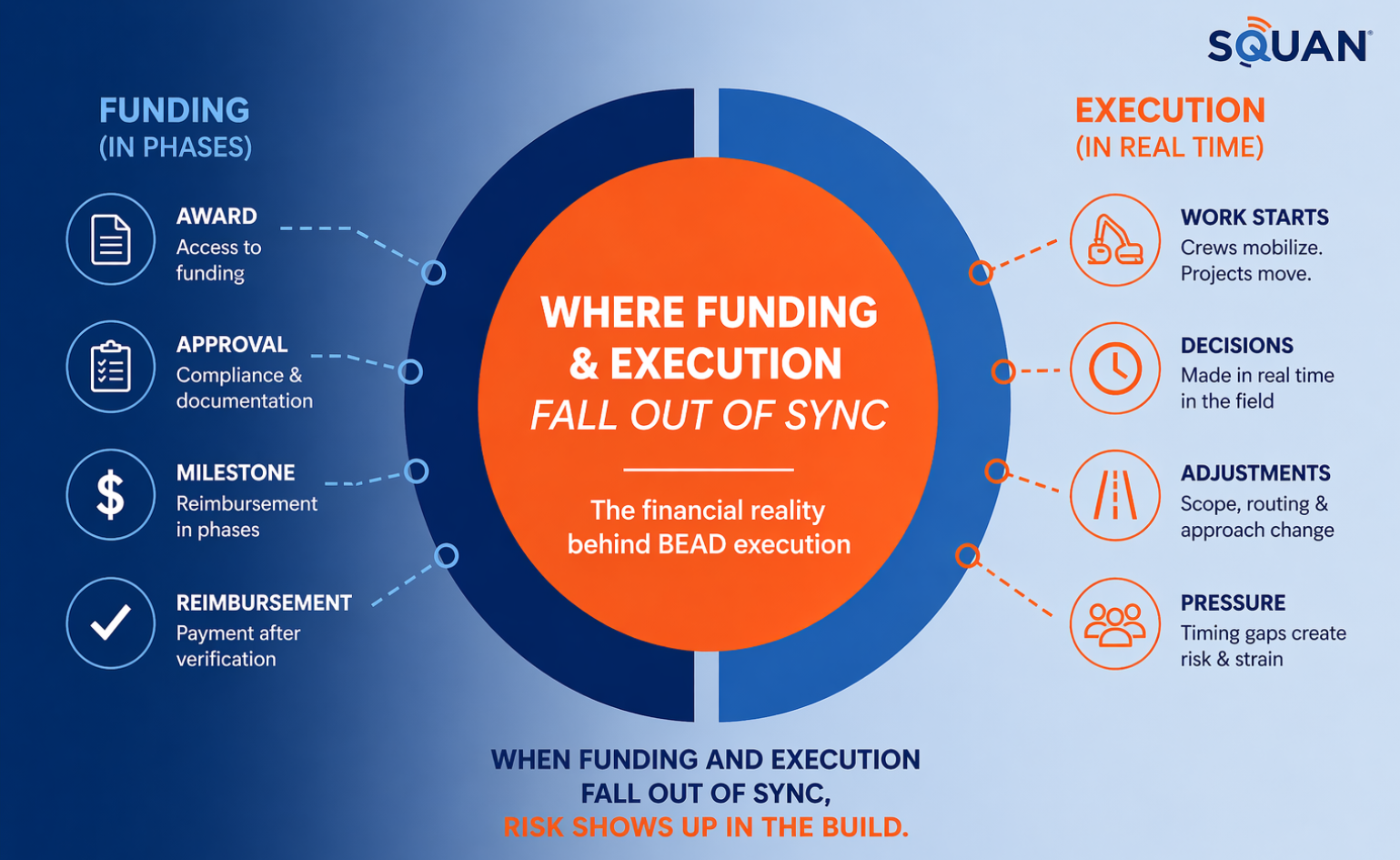
One of the most common assumptions heading into programs like BEAD is that an award equals accessible capital.

It doesn’t.

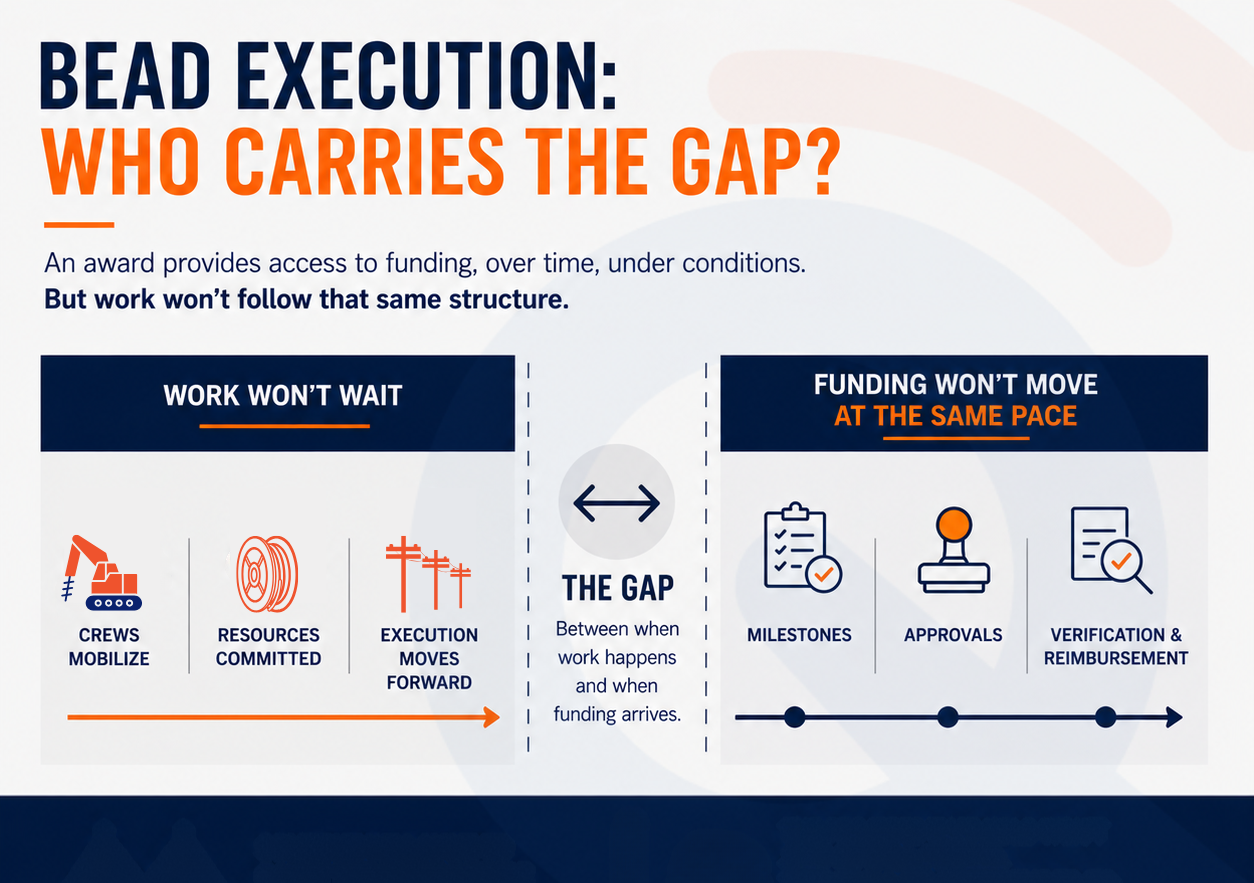
An award will provide access to funding.
That funding will be released over time.
And it will be tied to conditions.

Milestones.
Approvals.
Documentation.
Verification.

Which means funding won’t move at the same pace as construction.

And based on previous government programs, that difference is where pressure tends to build.

Work Will Move Continuously. Funding Will Not.

Construction doesn’t wait.

Crews will mobilize.
Materials will be ordered.
Projects will move forward in real time.

But funding will follow a different path.

It will arrive in phases.
Often at the beginning.
Often at the end.
And more selectively through the middle.

That creates a gap between when work happens and when funding is received.

Early on, that gap may feel manageable.

At scale, it becomes harder to absorb.

The Gap Will Have to Be Carried

When funding and execution don’t align, the impact won’t stay in financial models.

It will show up in how projects are carried.

Because someone will have to bridge that gap.

Working capital won’t appear automatically.
Cash flow won’t smooth itself out.
And reimbursement timelines won’t adjust to field conditions.

That leads to a critical question:

Who will carry the project between milestones?

In many cases, that won’t be fully defined upfront.

And that’s where risk is likely to build.

Where Execution Pressure Is Likely to Show Up

If funding structure doesn’t align with how work progresses, the effects will be visible:

  • Projects may become harder to sustain at full pace
  • Decisions may compress under financial pressure
  • Risk may shift between operators and contractors
  • Execution may start to move differently than planned

Not because anything is broken.

But because the system supporting execution wasn’t designed around how execution actually works.

Why This Will Matter More in BEAD

The industry has seen versions of this dynamic before.

But BEAD introduces additional variables that will likely amplify the impact:

  • Larger funding allocations
  • A broader range of awardee profiles
  • Increased compliance requirements
  • More defined milestone structures
  • Greater pressure to deploy at scale

For some participants, this may be their first time managing programs at this level of complexity.

Which makes the structure behind funding even more important.

Execution Won’t Be Just Operational. It Will Be Financial.

There’s a common industry phrase: funding doesn’t build networks, execution does.

That will remain true.

But execution won’t operate independently from funding.

It will depend on it.

Not just in total dollars, but in timing, structure, and accessibility.

Execution is where engineering, construction, and capital meet in real time.

If one of those elements falls out of alignment, the impact will be immediate.

What Stronger Structures Will Require

The projects that move successfully won’t just be well-funded.

They will be structured to support execution from start to finish.

That will require:

  • Understanding how cash flows through the full lifecycle of a project
  • Planning for the middle phases, not just the start and finish
  • Aligning funding expectations with real-world build timelines
  • Defining how working capital is managed across stakeholders
  • Treating financial structure as part of execution, not separate from it

Because at scale, structure will determine stability.

As BEAD moves closer to deployment, the conversation will continue to evolve.

From how much funding is available
To how that funding supports execution

The difference between those two is where projects will either hold or begin to drift.

For teams planning ahead, aligning funding structure with execution early may be one of the most important decisions made before construction begins.

On paper, BEAD represents one of the most significant infrastructure investments the industry has seen.

Funding is allocated.
Awards are announced.
Build plans begin to take shape.

From a distance, it looks like momentum.

But inside active deployment conversations, a different reality is starting to surface.

Because an award is not the same as execution.

The Gap Between Award and Execution

A BEAD award provides access to funding. It does not immediately function as deployable capital.

That funding is tied to:

  • Milestone-based reimbursement structures
  • Compliance requirements
  • Approval timelines
  • Documentation and verification processes

Which means the flow of capital does not always align with the pace of construction.

Projects move in real time.
Funding moves in phases.

That gap is where risk begins to build.

Timing Is the Real Constraint

One of the most underestimated challenges in BEAD execution is timing.

Milestone payments often provide funding at the beginning and end of a project, but the middle phases, where the majority of work occurs, require consistent cash flow to maintain progress.

If that gap is not planned for upfront, it creates pressure on both operators and contractors.

And in some cases, it can stall projects that otherwise have full funding behind them.

Because projects don’t fail only due to lack of funding.

They fail when funding and execution fall out of sync.

The Contractor Relationship Is Evolving

Another shift happening under BEAD is the changing dynamic between awardees and contractors.

In traditional builds, pricing and scope often define the relationship.

Under BEAD, that’s no longer enough.

Execution at this scale requires alignment on:

  • Working capital expectations
  • Cash flow timing
  • Risk exposure
  • Financial structure throughout the build

When those conversations don’t happen early, contractors can end up absorbing timing gaps that were never intended to be part of the relationship.

And that’s where projects begin to break down.

Financial Decisions Show Up in the Field

These challenges don’t stay in spreadsheets.

They show up in real, physical ways:

  • Changes in construction approach
  • Adjustments to routing decisions
  • Delays in mobilization
  • Slowed production in critical phases

What starts as a financial structure decision ultimately impacts how and when networks get built.

Funding Is Part of Execution

It’s often said that funding doesn’t build networks, execution does.

That’s true.

But execution doesn’t operate independently from funding.

Funding structure, timing, and availability are part of execution.

And as BEAD moves from allocation to delivery, the operators who recognize that early will be better positioned to move projects forward without disruption.

Because the challenge ahead is not just deploying capital.

It’s aligning capital with execution.

As networks scale, performance isn’t just about uptime.

It’s about anticipation.

The ability to see issues before they disrupt service.
To prioritize maintenance before failures occur.
And to manage increasingly complex systems without adding unnecessary strain to operations.

For many operators, that shift is becoming unavoidable.

The limits of reactive maintenance

For years, network maintenance has followed a familiar model.

Something breaks.
A team responds.
The issue gets resolved.

At smaller scales, that works.

But as infrastructure expands across markets, that approach starts to show its limits.

More assets mean more potential points of failure.
More complexity makes issues harder to isolate.
And more demand reduces the margin for downtime.

In that environment, reacting after the fact becomes increasingly costly.

Not just in repairs, but in lost time, resources, and performance.

Where visibility becomes the differentiator

The challenge isn’t just identifying failures.

It’s identifying them early enough to act.

Signals exist long before an outage occurs.

Subtle shifts in performance.
Patterns in equipment behavior.
Data points that, on their own, may not seem urgent.

But together, they tell a story.

Without visibility into those signals, teams are left responding to symptoms instead of addressing root causes.

The shift toward predictive operations

This is where predictive models are beginning to change how networks are managed.

By analyzing historical data, equipment logs, and real-time inputs, operators can start to identify patterns that indicate potential failure.

Not with perfect certainty.

But with enough confidence to take action earlier.

That shift allows teams to:

  • Prioritize maintenance based on risk, not routine
  • Reduce unnecessary interventions
  • Minimize downtime before it happens

It’s not about replacing operational expertise.

It’s about strengthening it with better information.

Why this matters now

As deployment accelerates and networks become more interconnected, the cost of disruption increases.

Waiting for failure is no longer a neutral decision.

It’s a risk.

The operators who maintain performance at scale aren’t just reacting faster.

They’re identifying issues sooner and acting with greater precision.

A broader shift in how networks are being managed

Predictive maintenance is just one example of a larger change happening across the industry.

As networks grow, so does the need for:

  • better coordination
  • stronger visibility
  • more proactive decision-making

In our Q1 Quarterly, we explore how this shift is taking shape, along with other trends impacting network deployment and operations across 2026.

Read the full Q1 Quarterly

Stay connected with future insights and quarterly updates: Newsletter Sign Up

Fiber expansion across the U.S. isn’t slowing down.

But as broadband programs move from planning into execution, a different challenge is emerging.

Not funding.
Not demand.

Execution alignment.

Across engineering, permitting, and construction, deployment is becoming more complex as programs scale across multiple markets and jurisdictions. And in this phase, small gaps don’t stay small.

They compound.

That’s where timelines slip.
And where strong programs begin to separate from the rest.

The gap between progress and readiness

On paper, most network builds appear aligned.

Permits are approved.
Designs are complete.
Construction is scheduled.

But those milestones don’t always reflect what’s actually ready to be built.

And that gap, between reported progress and real-world readiness, is where execution begins to break down.

As deployment scales, that distinction becomes harder to manage and more costly to ignore.

What’s shaping deployment right now

In our Q1 Quarterly, we take a closer look at the shifts shaping network deployment across 2026, including:

  • Where BEAD-funded programs are encountering friction as they move into execution
  • How AI is shifting maintenance from reactive to predictive
  • What increased merger and acquisition activity signals for the market
  • Why data center growth is as much a fiber challenge as it is a power challenge
  • How emerging technologies like multicore fiber are changing capacity planning

These aren’t future considerations.

They’re showing up in active deployments today.

Read the full Q1 Quarterly

Stay connected with future insights and quarterly updates: Newsletter Signup