
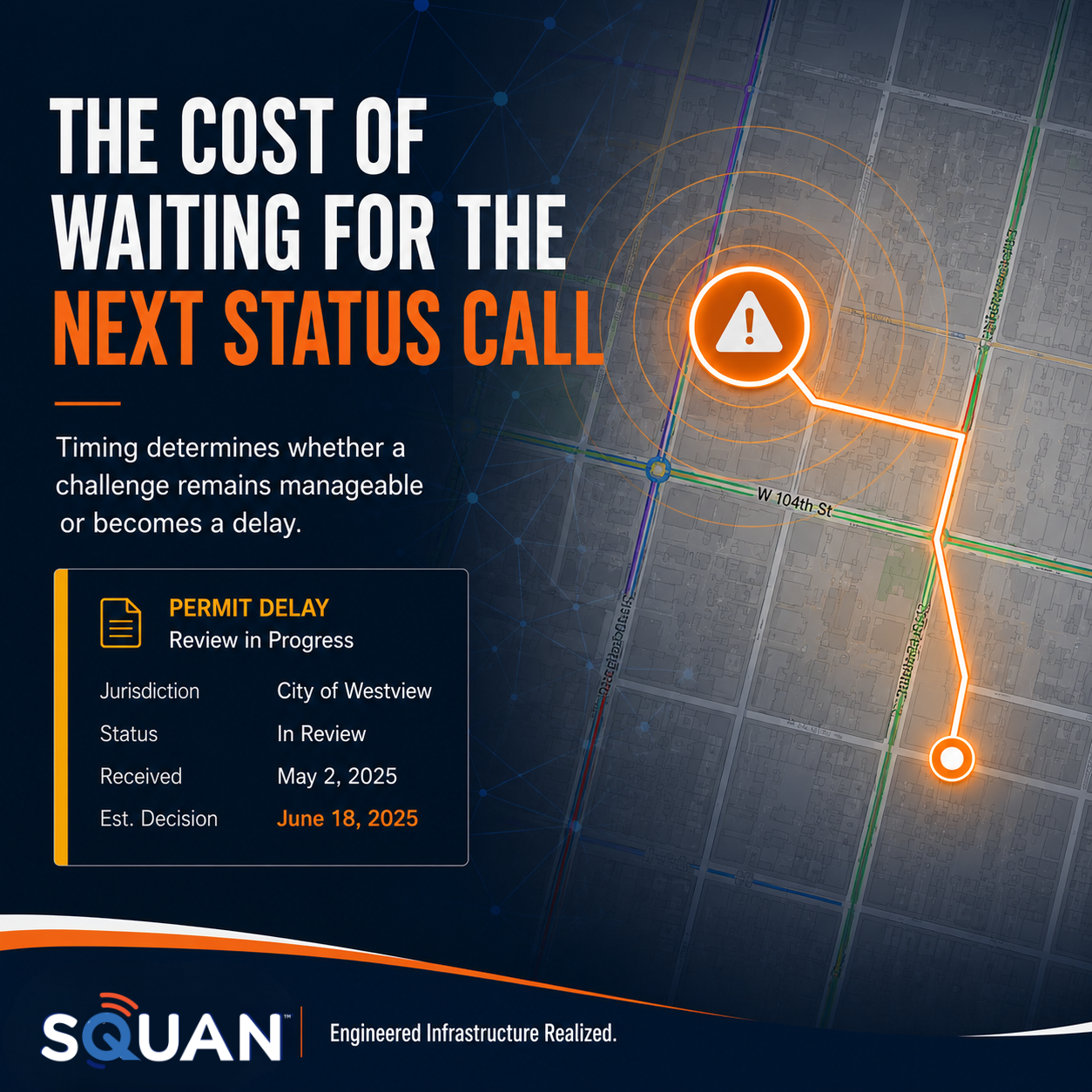
The Cost of Waiting for the Next Status Call
Why Operational Awareness Is Becoming a Competitive Advantage in Deployment
Deployment challenges are not new.
Permit delays happen. Field conditions change. Construction sequencing shifts. Unexpected constraints emerge. Every infrastructure program will encounter obstacles throughout the course of execution.
The difference between programs that maintain momentum and those that struggle to recover is often not the presence of challenges themselves.
It is how quickly those challenges become visible.
For many organizations, visibility still operates on a reporting cadence. Information is collected, consolidated, reviewed, and communicated through scheduled meetings, project updates, and status reports. While those processes have long been standard practice, they were developed for an operating environment that moved much slower than the one many deployment organizations face today.
As programs continue to grow in scale, waiting for the next report or the next status call can create a costly gap between operational reality and organizational awareness.
Challenges Become More Expensive Over Time
A permit delay identified weeks before construction begins is usually manageable.
Project teams have time to adjust sequencing, shift resources, modify schedules, and coordinate alternative paths forward. The challenge exists, but so do the options available to address it.
The same permit delay discovered only days before mobilization creates a very different situation.
Crews may already be scheduled. Materials may already be allocated. Construction plans may already be dependent on activities that can no longer move forward as expected.
The challenge itself has not changed.
The number of available responses has.
This principle extends well beyond permitting. Field conditions, restoration issues, design changes, material availability, and construction dependencies all follow a similar pattern. The longer a developing issue remains unseen, the fewer options organizations typically have to respond effectively.
Visibility Is No Longer a Reporting Function
Historically, deployment visibility was often viewed as a reporting function.
Organizations focused on understanding what had already happened, measuring progress against schedules, and communicating status to stakeholders.
Today’s deployment environment requires something different.
Operational leaders increasingly need visibility that supports decision-making while options still exist. The objective is no longer simply understanding project performance. It is understanding emerging constraints early enough to influence outcomes.
This shift changes how organizations think about visibility.
Instead of asking whether a challenge has occurred, teams are increasingly asking whether they can see it forming.
The Value of Seeing What’s Next
As deployment programs scale across multiple markets, jurisdictions, contractors, and workstreams, maintaining awareness becomes significantly more difficult.
Engineering, permitting, construction, restoration, and closeout activities all influence one another. A change in one area can create downstream impacts long before they become visible through traditional reporting channels.
Organizations that maintain schedule confidence are often the ones that can identify those impacts early enough to respond.
Not because they avoid challenges.
Because they understand them sooner.
Operational awareness creates the opportunity to adjust sequencing, prioritize resources, coordinate teams, and preserve schedule flexibility before recovery becomes necessary.
In many cases, the difference between a manageable issue and an expensive delay is simply how quickly teams become aware of what is happening.
Looking Beyond the Next Status Call
Infrastructure deployment continues to become more complex, more connected, and more dependent on coordinated execution.
As that complexity increases, the organizations that succeed will not necessarily be those that encounter fewer challenges.
They will be the organizations that can see challenges sooner, understand their potential impact faster, and respond before delays begin compounding throughout the program.
Because in modern deployment operations, timing does not just influence decisions.
It influences outcomes.
Download our cornerstone guide: