
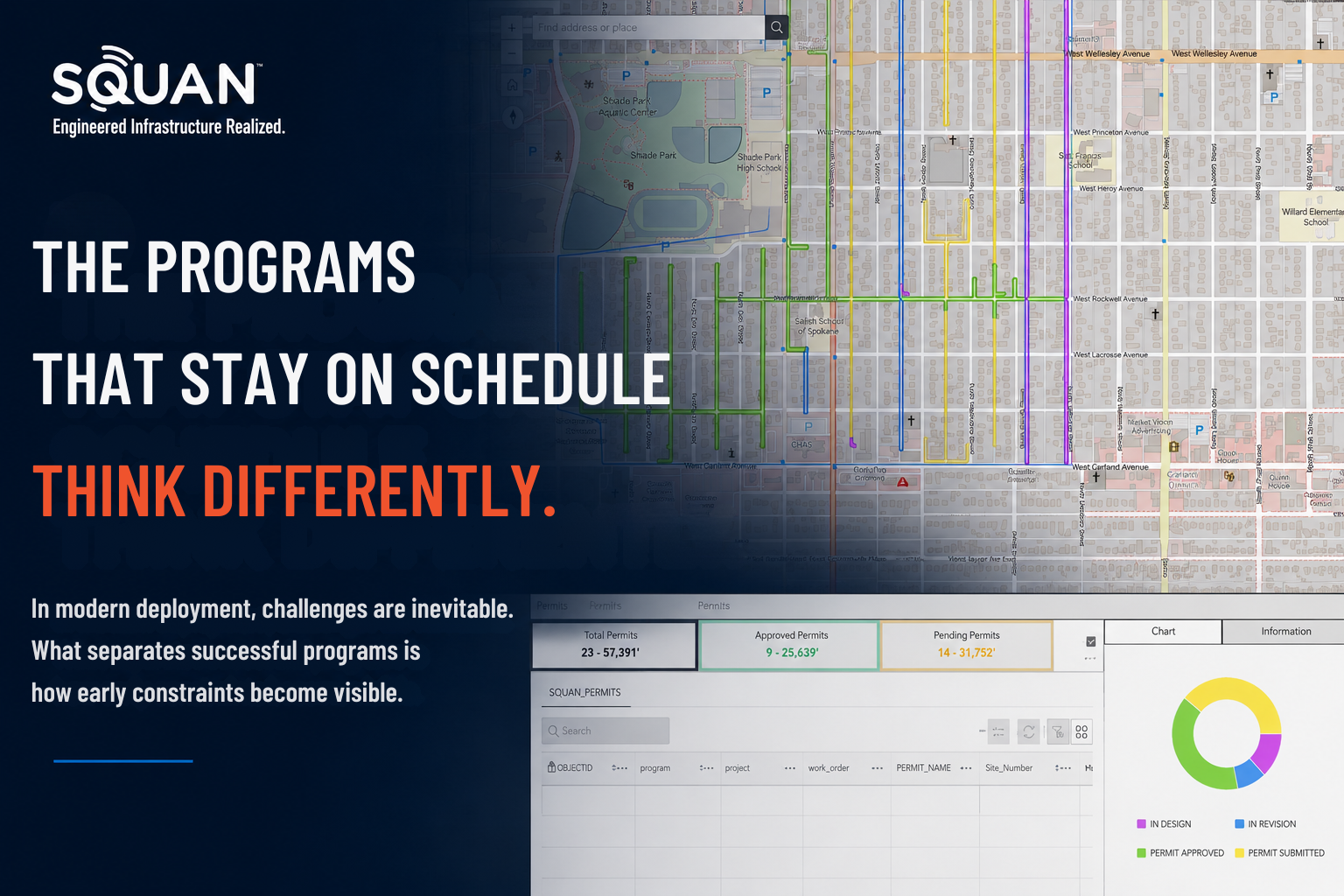
The Programs That Stay on Schedule Think Differently
Every deployment program encounters challenges.
Permits take longer than expected. Field conditions change. Utility coordination introduces new dependencies. Construction sequencing shifts. None of these realities are unique. They are part of modern infrastructure deployment.
Yet some programs consistently maintain schedule confidence while others find themselves constantly working to recover lost time.
The difference is rarely the absence of obstacles.
More often, it comes down to how early those obstacles become visible.
The Visibility Advantage
As deployment programs continue to scale across multiple markets and jurisdictions, the speed at which teams can identify and respond to constraints has become increasingly important.
Many organizations still rely on reporting structures that summarize what happened last week. While those reports provide useful information, they often arrive after critical decisions have already been made.
By the time an issue appears in reporting, crews may already be scheduled, materials allocated, and construction plans set in motion.
The challenge is not a lack of information.
The challenge is timing.
A constraint identified early creates options. The same constraint identified late creates consequences.
Why Timing Changes Everything
Consider a permit delay.
When teams become aware of the delay weeks before construction begins, they can adjust sequencing, prioritize alternative work, and continue moving the program forward.
When the same delay surfaces days before crews mobilize, the conversation changes. Schedules compress. Resources shift. Stakeholders need updates. Recovery planning replaces proactive planning.
The permit itself did not become more complicated.
The response became more expensive.
This pattern repeats across nearly every deployment program. Whether the issue involves permitting, field conditions, utility coordination, or resource availability, the sooner teams understand what is happening, the more control they have over what happens next.
Controlled Execution Is Not About Avoiding Challenges
One misconception in deployment operations is that successful programs experience fewer obstacles.
In reality, complexity is increasing across the industry.
Funding requirements are tightening. Jurisdictional requirements vary widely. Programs are operating across larger geographic footprints than ever before.
Challenges are inevitable.
Controlled execution is not about eliminating uncertainty. It is about creating enough visibility to manage uncertainty before it impacts delivery.
Programs that maintain schedule confidence do not wait for issues to appear in reporting. They identify constraints while options still exist. They adjust sequencing before schedules compress. They make decisions before recovery becomes necessary.
Visibility Creates Confidence
At its core, operational visibility is about more than status reporting.
It creates confidence.
Confidence that schedules reflect reality.
Confidence that teams are working from the same information.
Confidence that stakeholders understand the true state of the program.
Most importantly, it gives organizations the ability to respond before obstacles become the story.
As deployment programs continue to grow in scale and complexity, visibility is becoming one of the most important operational advantages a team can have.
Because the difference between staying on schedule and falling behind is often not the challenge itself.
It is how early you see it.
View the Full VECTOR Cornerstone
Want to explore how fragmented visibility impacts deployment execution and what it takes to regain operational control?
View, When You Can’t See All the Pieces, You Can’t Put It All Together, SQUAN’s cornerstone guide on operational visibility, deployment complexity, and execution at scale.