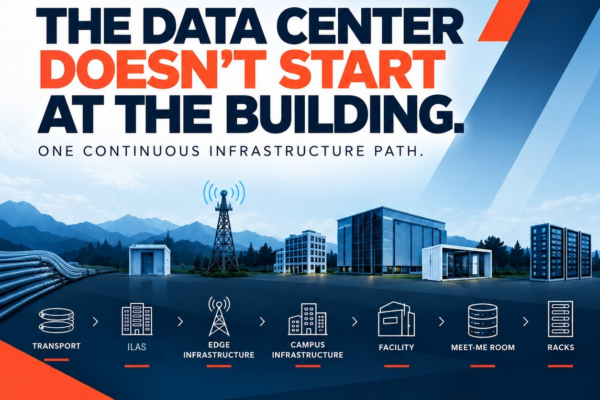
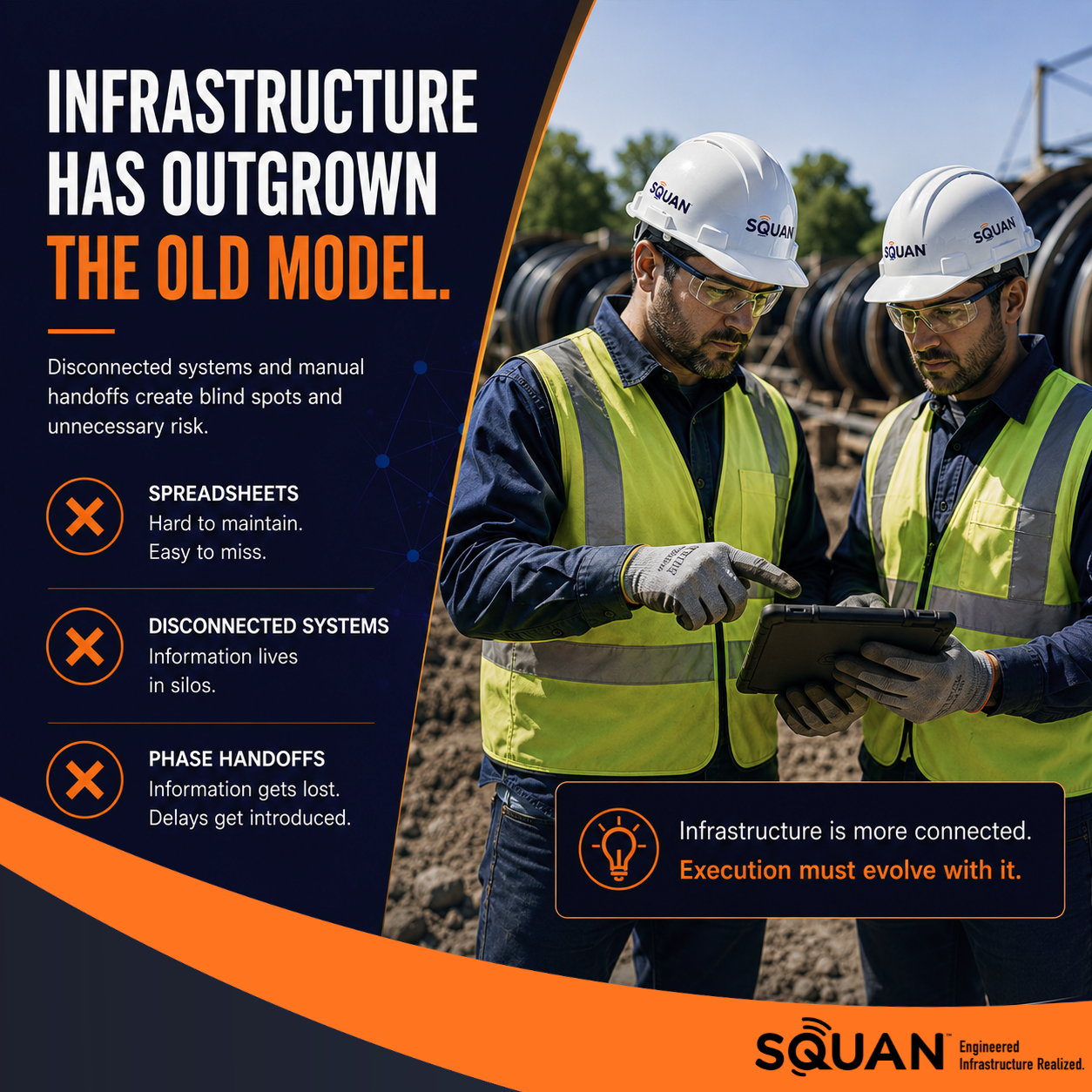
Infrastructure Has Outgrown the Old Model
Why Deployment Operations Are Moving Beyond Spreadsheets, Status Reports, and Phase-Based Handoffs
Infrastructure deployment has become significantly more complex over the last decade.
Projects now span larger geographic footprints, involve more stakeholders, and require greater coordination between engineering, permitting, construction, restoration, and closeout activities. As programs continue to scale, the relationships between these workstreams have become just as important as the work itself. What happens in one area of a deployment can influence outcomes across multiple teams, often long before those impacts become visible through traditional reporting channels.
Despite this shift, many organizations continue to manage deployment operations using processes that were developed for a much different environment.
Spreadsheets, static reports, departmental updates, and phase-based handoffs have long served as the foundation of project management. For years, these approaches were sufficient because projects moved at a pace where information could be collected, communicated, and acted upon without creating significant operational risk.
Today’s deployment environment demands something different.
Complexity Has Changed the Equation
Most deployment challenges are no longer isolated events contained within a single workstream.
A permitting delay can influence construction sequencing. A field condition can require design modifications. A schedule adjustment can affect resource planning across multiple markets and crews. As programs become larger and more interconnected, the ripple effects of seemingly minor issues become increasingly difficult to predict and manage.
Organizations are no longer being asked to oversee individual activities alone. They are being asked to manage the relationships and dependencies that exist between those activities.
This is where many traditional operating models begin to show their limitations.
Engineering teams often manage one set of information, permitting teams manage another, and construction teams operate from their own schedules and updates. While each group may have visibility into its specific responsibilities, maintaining a clear understanding of how those responsibilities influence the broader program becomes much more challenging.
The problem is rarely a lack of information.
The problem is understanding how information from one workstream affects decisions, priorities, and outcomes across the rest of the deployment.
The Hidden Cost of Disconnected Execution
Disconnected systems create more than administrative inefficiencies. They create operational blind spots.
Information may exist somewhere within the organization, but if it is not visible to the right people at the right time, its value becomes significantly diminished. Teams can unknowingly make decisions based on outdated assumptions, emerging risks can go unnoticed, and critical dependencies may not become apparent until they begin affecting schedules, budgets, or resource allocation.
As deployment programs grow, these gaps in awareness become increasingly expensive.
The challenge is not that organizations are collecting too little information. In many cases, they are collecting more information than ever before. The challenge is that information often remains fragmented across multiple systems, teams, and reporting processes, making it difficult to understand how individual updates influence the broader program.
Readiness Is No Longer a Departmental Metric
Historically, project readiness was often measured through the progress of individual departments.
Engineering was complete. Permits were approved. Construction was prepared to mobilize.
The assumption was that if each workstream was progressing according to plan, the project itself was progressing according to plan.
Today’s deployment environment requires a more connected perspective.
Project readiness is increasingly determined by how well workstreams align with one another. A project may appear ready from one viewpoint while hidden constraints continue developing elsewhere. Permits may still be pending, field conditions may have changed, or construction sequencing may no longer reflect current realities.
Understanding readiness now requires visibility beyond individual tasks and milestones. It requires an understanding of how engineering, permitting, construction, restoration, and closeout activities collectively influence delivery.
The question is no longer whether information exists.
The question is whether organizations can understand what that information means for the broader program.
A Different Approach to Deployment Operations
As infrastructure programs continue to scale, organizations are beginning to rethink how operational visibility is created and maintained.
The focus is shifting away from simply collecting information and toward creating a more connected understanding of project execution. Rather than relying solely on periodic reports or departmental updates, leading organizations are seeking ways to maintain awareness across the entire deployment lifecycle.
The objective is not simply better reporting.
The objective is creating the awareness needed to identify risks earlier, make more informed decisions, and maintain schedule confidence as complexity increases.
Because infrastructure itself has become more connected than ever before.
The way organizations manage execution must evolve alongside it.
To explore this concept further, download our cornerstone guide: