Fiber deployment across the United States is not just gaining momentum; it’s evolving into a transformative force for communities and businesses alike:

  • Capital is flowing into innovative solutions.
  • Programs are transitioning from planning to dynamic execution.
  • Construction capacity is scaling to meet rising demand.

Yet many network builds encounter friction when projects hit the field.

The Real Constraint: It’s Not What You Think

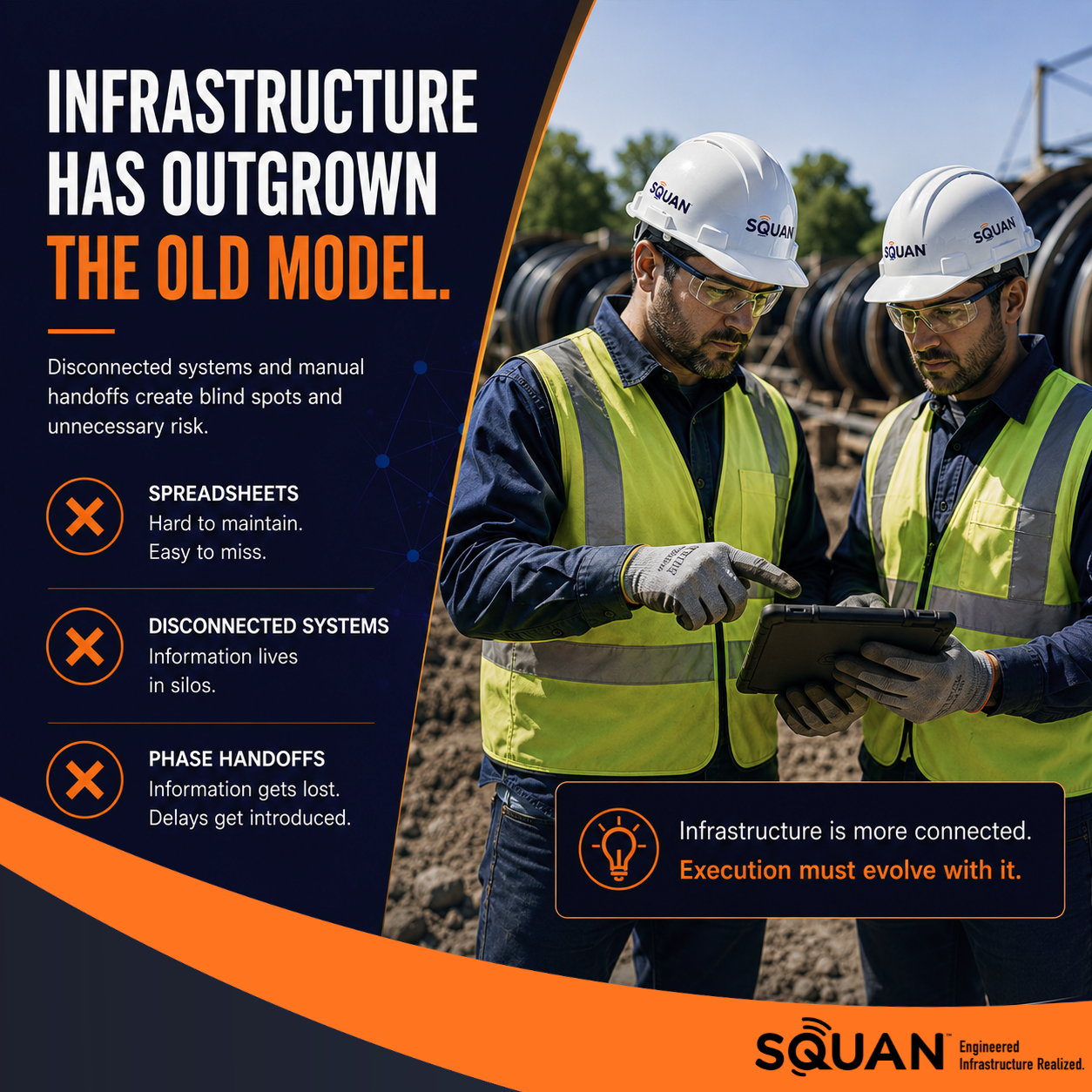
Surprisingly, the constraint isn’t labor or technology. The real issue lies in the gaps between engineering, permitting, and construction execution.

Where Execution Breaks Down

Network builds rarely fail in a single moment. Instead, they lose momentum through minor misalignments:

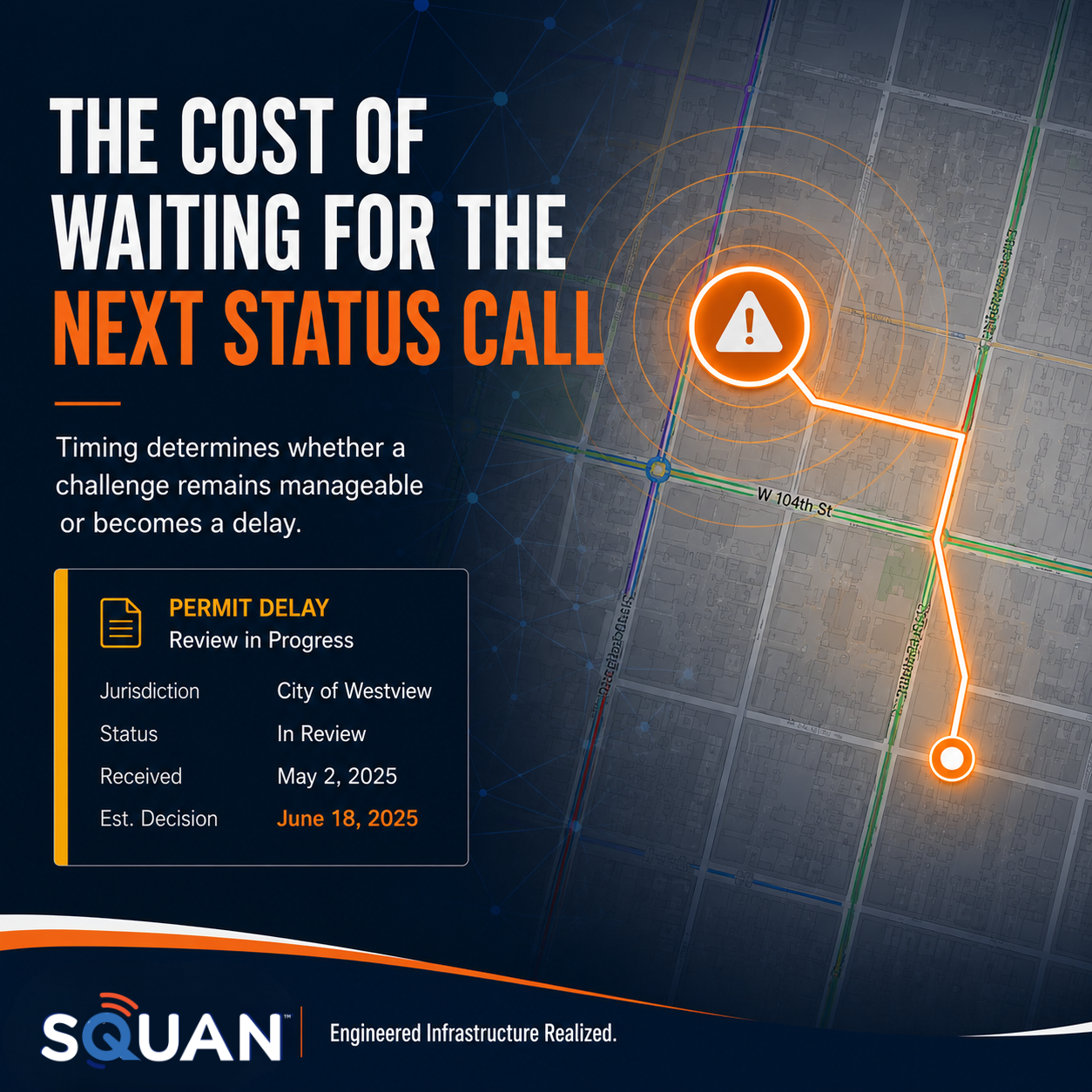
  • Design changes occur after permits have been submitted.
  • Crews mobilize before routes are fully cleared.

Individually, these issues may seem manageable. However, across large deployment programs, they can snowball, leading to significant delays and eroded confidence.

Why Integrated Execution is Key

Operators need integrated execution across all phases to maintain momentum and avoid compounding issues. When engineering, permitting, and construction work in harmony, projects thrive, timelines are respected, and everyone benefits.

Download the Network Deployment Guide

Large-scale network builds introduce complexities that aren’t always visible from the outside.

SQUAN has developed a comprehensive guide that explores where deployment programs often encounter friction and how operators can maintain momentum as builds scale across multiple markets.

Download the full guide to discover the execution challenges shaping today’s fiber deployments and how to overcome them!

As fiber deployment accelerates across the U.S., operators are navigating increasing complexity across engineering, permitting, and construction. Network deployment is entering a more demanding phase as broadband programs move from planning into execution.

SQUAN developed this guide to examine where network deployment programs most often encounter friction and how operators can maintain momentum as infrastructure builds scale across multiple markets and jurisdictions.

The guide explores the operational realities behind large network builds and highlights why execution discipline, permitting visibility, and coordination across phases are critical to maintaining schedule control.

For operators navigating BEAD pressure and large-scale infrastructure deployment, this guide provides a practical perspective on the execution challenges shaping today’s broadband expansion.

Download the Full Guide (PDF)

The fiber land grab is not theoretical. It is happening.

Across competitive FTTH markets, capital is flowing, and private equity-backed builders are expanding aggressively. Deployment velocity has become the dominant signal of success. Passings are measured, territory is tracked, and expansion speed is rewarded. However, operational durability, often overlooked, ultimately determines long-term value.

The Central Tension: Speed vs. Sustainability

The central tension shaping today’s FTTH market is simple: Are networks being engineered for sustainable operation, or are they optimized for near-term deployment metrics? These strategies are fundamentally different.

When Metrics Begin Driving Engineering Decisions

In high-competition environments, deployment metrics begin to influence engineering judgment.

  • Cost per passing becomes a constraint.
  • Monthly production targets become non-negotiable.
  • Market activation timelines tighten.

Under this pressure, critical sequencing decisions may shift. For instance, pre-positioned drop conduits might be deferred in underground builds, and terminal placements can be treated as operational phases rather than construction requirements. While individually rational, these decisions collectively redefine the long-term operating profile of the network.

Short-term acceleration often transfers complexity downstream into operations, maintenance, and customer experience. The trade-offs do not disappear; they compound.

Optimization or Deferred Exposure

Not every acceleration tactic is reckless. Leadership teams often make deliberate trade-offs based on capital structure and competitive dynamics. However, one unavoidable question remains: Is the organization structuring this network for decades of operation, or for a compressed monetization timeline?

Simplifying construction in ways that complicate long-term serviceability may improve early metrics, but it does not reduce total lifecycle costs. Shortcuts manifest later as higher operational expenses, increased truck rolls, strained municipal relationships, and valuation scrutiny during due diligence.

The Fragility of Assumptions

The land grab environment encourages aggressive modeling, relying on assumptions that may not hold. For example:

  • It assumes underground production rates remain stable across markets.
  • It assumes aerial access will resolve within projected windows.
  • It assumes municipal coordination can be compressed.

In practice, these assumptions are highly sensitive to local realities. Ground conditions, aerial deployments, and labor capacity can dramatically distort cost models and timelines.

The Illusion of Readiness

Many organizations claim readiness. They have secured capital, recruited experienced executives, and defined their build plans. But readiness is not solely financial.

  • Have franchise agreements been executed at the operational level?
  • Are municipal managers aligned, not just executive stakeholders?
  • Are pole authorities engaged early and realistically?

Fiber deployment is not transactional; it is relational. The most successful builders engage municipalities twelve to eighteen months before construction, aligning expectations and building trust to minimize friction.

Fragmentation as Hidden Risk

Acceleration often increases vendor fragmentation, distributing engineering, permitting, and construction management across multiple entities. Each handoff introduces delay risk and increases coordination complexity.

Integrated execution models reduce these friction points. In high-velocity deployment environments, integration is not merely a preference; it is a crucial risk mitigation strategy.

The Real Cost of Getting It Wrong

The financial risks are measurable: extended payback periods, elevated operational expenses, and compressed acquisition multiples. However, the organizational risks are equally significant:

  • Crew instability under unrealistic production assumptions.
  • Municipal resistance following misaligned communication.
  • Internal fatigue when timelines collapse under friction.

In a landscape where many players are building toward eventual acquisition, inefficiencies in process and durability directly impact enterprise value. Speed alone does not enhance valuation; sustainable performance does.

What Differentiates the Winners

The organizations navigating this environment effectively share one defining characteristic: structural nimbleness. They validate assumptions early, pivot quickly when dynamics shift, and do not defend outdated strategies.

  • If underground assumptions fail, they adjust.
  • If aerial access stalls, they reassess sequencing.
  • If municipal friction rises, they recalibrate engagement immediately.

A Question for Executive Teams

For boards and leadership teams evaluating deployment progress, the most critical question may not be about cost per passing. It is this: Are our assumptions grounded in field reality and municipal alignment, or in optimistic modeling?

Capital accelerates construction but does not override local realities indefinitely. The FTTH land grab will yield clear winners and underperformers. The winners will be those who build networks that are durable, serviceable, and positioned for long-term value creation.

Ready to Build for the Future?

In this evolving landscape, the margin for error is slim. Before finalizing your FTTH strategy, consider a briefing to pressure-test your assumptions and explore sustainable practices. Reach out to us to see what’s possible.

THE BEAD wait is finally over… or is it?

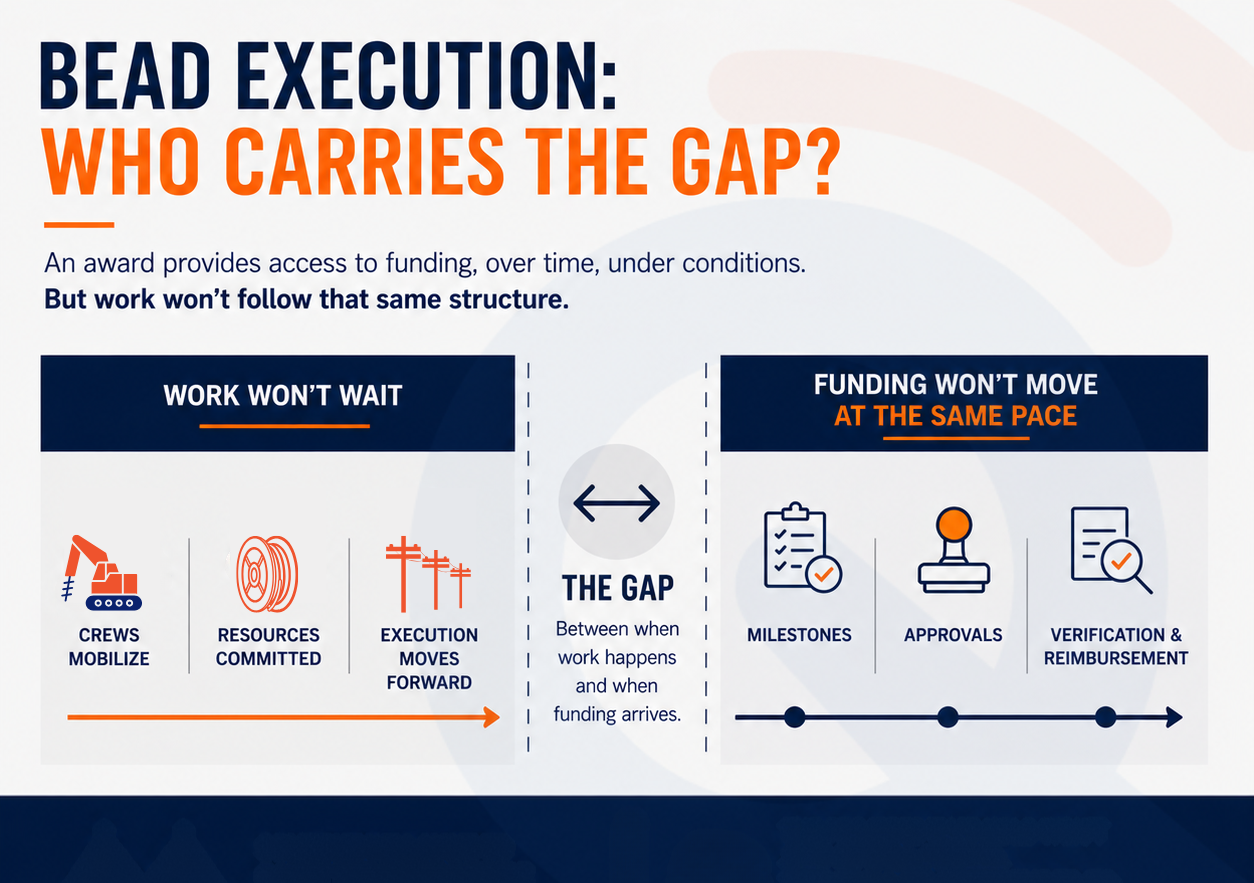
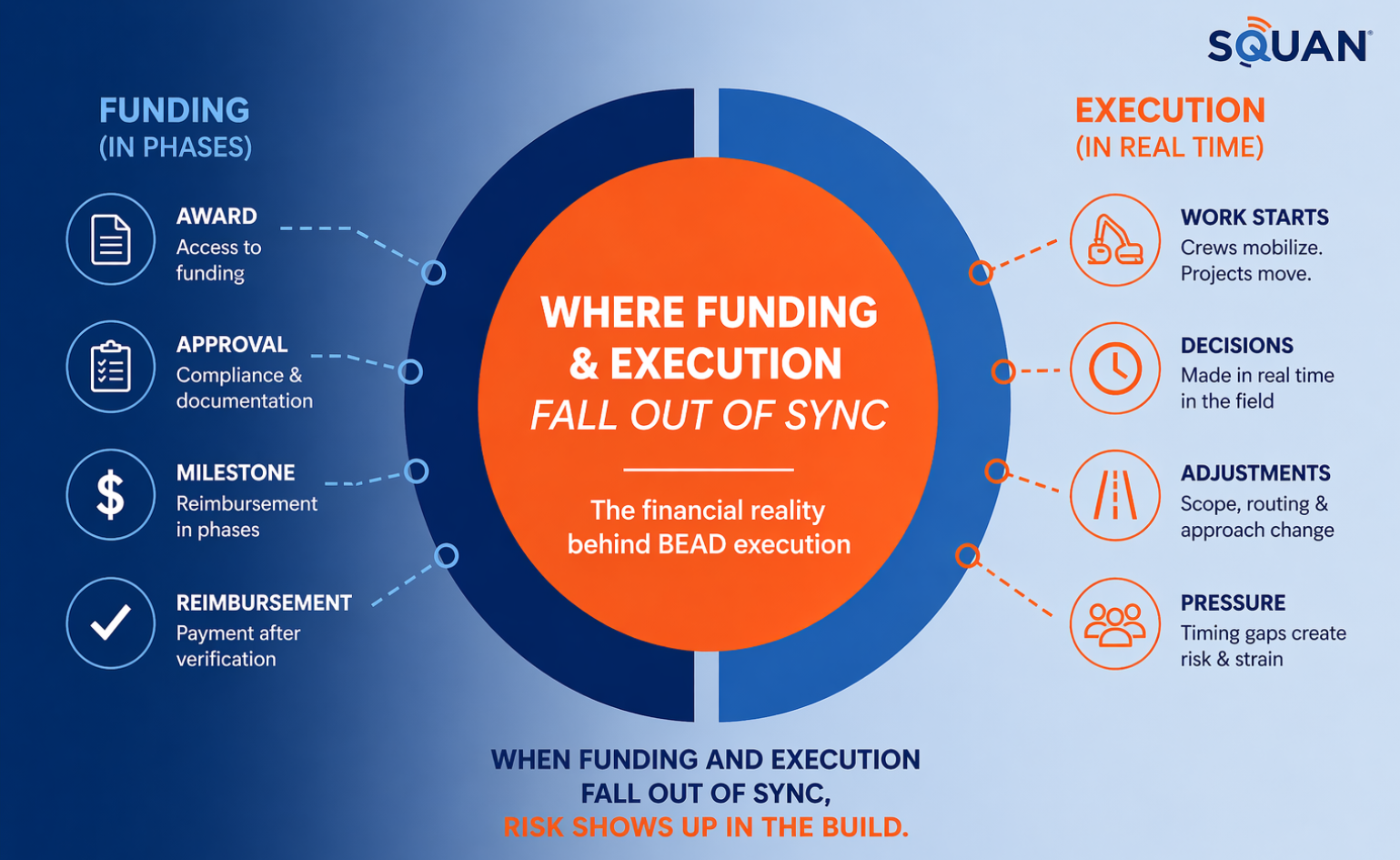
While the promise of BEAD is finally becoming real: funding is moving toward activation. Planning is giving way to execution. The reality may not be that clear cut.

States are now deep in BEAD funding review. Most have submitted final proposals to the National Telecommunications and Information Administration, and many are already approved. On paper, this looks like progress. In reality, this is just the starting line.

Funding does not build networks. People, plans, and execution do. And the environment is shifting fast enough to catch even experienced teams off guard. Leaders in broadband delivery need to answer one question now, not later. How will you execute when funding clears and the clock starts?


Timing Is Uncertain and Changing

The BEAD program has already proven one thing. Conditions will change midstream. States paused and restarted parts of their programs as federal guidance evolved. Provisional awards were rescinded. Rules were clarified, revised, and reissued. Timelines compressed. Expectations shifted. These are not minor adjustments. Each reset forces Eligible Entities to revisit location data, rerun funding rounds, and rebuild schedules under tighter windows.

For engineering and planning teams, this creates cascading risk. Designs age. Permits delay. Construction timelines didn’t shrink so much as reset, like a shot clock after a stoppage. Everyone gets the same time when play resumes, but not everyone is ready to use it. Teams that were already set up, balanced, and reading the floor can execute immediately. Those advantages do not happen by accident. They belong to teams that built flexibility into their execution model from the start.


Eligibility and Data Reality Matters

BEAD exposed a hard truth about broadband planning. Data is never static. Updated FCC maps and evolving state challenge processes continue to shift which locations qualify, requiring teams to reassess eligibility assumptions as planning moves forward.

That shift matters immediately. Eligibility data drives route planning, density assumptions, capital models, and crew forecasts. When the data moves, everything downstream moves with it.

Engineering teams that treat eligibility as a settled fact are running a set play without watching the shot clock. When BEAD rules shift, designs drift out of alignment with funding reality before the ball ever leaves their hands. Rework, redesign, and cost overruns follow quickly.

Stable execution requires constant validation. Not one review. Ongoing discipline.


The Cost and Technology Debate Is No Longer Theoretical

BEAD’s move toward technology neutrality changed the calculus. Lower-cost solutions can now compete more aggressively for funding. Fixed wireless and LEO (low earth orbit) satellite options score well on upfront economics. Fiber no longer wins by default.

Engineering leaders should pause here. Lowest cost per location does not equal lowest cost over time. It does not guarantee scalability. It does not reduce future overbuild risk. And it does not eliminate performance tradeoffs once networks are live.

These decisions shape networks for decades, not grant cycles. Treating technology selection as a scoring exercise rather than a lifecycle decision is one of the fastest ways to undermine long-term value.


Timing Isn’t Just Deadlines — It’s Market Risk

Every BEAD delay compounds pressure elsewhere. Permitting queues stack up. Long-lead materials collide with labor availability. Crews shift between projects as funding releases slide.

Small changes at the federal or state level ripple into months of disruption on the ground. This is not execution failure. BEAD hasn’t kicked off yet. These shifts force redesign during warm-up, before the game begins. Models built for fixed assumptions struggle here. Those designed for volatility enter ready to play.


In-House, Big Vendor, or Local Patchwork

Beyond funding and planning, BEAD forces a fundamental execution choice. Most providers fall into one of three paths, and each comes with tradeoffs.

Own the work in-house

This offers the appearance control. Engineering standards stay intact. Decision-making is tight. But BEAD-scale builds expose real limits. Staffing shortages. Burnout. Gaps in permitting, make-ready coordination, and construction oversight. Control without capacity still fails timelines.

Outsource to a large national contractor

Big vendors promise compliance and scale. They bring process and paperwork. They also bring layers. Decisions slow. Change orders grow. Access to leadership disappears once the contract is signed. Problems take longer to surface and longer to fix.

Rely on small local crews

Local shops move fast and seem to cost less upfront. They also lack integration. Engineering, permitting, and construction operate in silos. Documentation lags. Forecasting breaks. Quality varies by crew, not by standard.

Speed without discipline creates downstream failure. Every BEAD recipient must align rigor with accountability. These networks are not temporary assets. They must be engineered to last and built with transparency.


Practical Actions for Engineering and Planning Leaders

There are clear actions engineering and planning leaders can take now. Eligibility and serviceability data should be validated continuously, not once. Execution scenarios should account for funding timing shifts and rule changes. Contractors should be evaluated on predictability and management discipline, not just crew availability. Labor and materials should be secured early with flexibility as a cornerstone value. Technology choices should be assessed on lifecycle cost and long-term performance, not grant optics alone.


Short List of Key Actions

  1. Perform ongoing validation of eligibility, serviceability, and environmental constraints.
  2. Do early identification and orchestration of build-critical landmines — including long poles, make-ready complexity, environmental reviews, traffic control requirements, and other hard dependencies.
  3. Build multiple execution scenarios based on funding timing and rule shifts.
  4. Select partners based on predictability and management discipline not just price or crew availability.
  5. Get labor and materials nailed down but build flexibility into schedules.
  6. Evaluate technology on lifecycle cost and performance.

The decisions made now will determine whether BEAD networks perform long after the funding headlines fade.


Ready to Answer the Call

This is a rare inflection point for U.S. broadband infrastructure. BEAD represents scale the industry has never seen. It also brings pressure it has rarely managed well. The easy path leans on slow bureaucracy or fragmented execution. The smarter path demands disciplined planning, integrated engineering, and execution models built for change.

For subgrantees and network leaders preparing to move from planning into build mode, SQUAN brings experience from prior government programs, real-world execution insight, and a turnkey approach that reduces friction between design, permitting, and construction.

The opportunity is historic, but the margin for error is slim. Before locking in your BEAD execution strategy, consider a briefing to pressure-test your assumptions and understand your options. Book a time with us and see what’s possible.

SQUAN is proud to welcome Dan Mahoney and Ryan Haney as our newest Directors of Business Development, bringing decades of experience across telecommunications, fiber infrastructure, and next-generation network deployment.

Both leaders join SQUAN at a pivotal time for the industry, as providers accelerate fiber builds, modernize wireless networks, and prepare for large-scale programs that demand speed, precision, and turnkey execution. Their expertise strengthens our ability to meet those needs while continuing to expand our national footprint.

About Dan Mahoney

Dan brings nearly 30 years of experience spanning telecommunications, fiber, and data infrastructure. Throughout his career, he has worked across operations, engineering, and business development, giving him a rare end-to-end understanding of what it takes to design, build, and maintain high-performance networks.

He has played key roles in deploying metro, middle-mile, and long-haul fiber networks across the country, partnering with service providers, utilities, and developers to deliver scalable connectivity solutions. Dan’s technical background, combined with his ability to translate customer needs into actionable programs, makes him a strong addition to SQUAN’s growth strategy.

About Ryan Haney

Ryan joins SQUAN with nearly 20 years of experience across the cable, fiber, and broader network infrastructure landscape. With a foundation in engineering, network design, and strategic sales leadership, he has built a reputation for forging trusted client partnerships and delivering complex builds with clarity and precision.

His work has supported organizations navigating emerging technologies, capacity upgrades, and large-scale expansions. These kind of challenges where SQUAN’s integrated engineering and construction capabilities create meaningful impact. Ryan’s focus on client alignment and solution-based delivery fits directly into SQUAN’s approach to long-term partnership.

A Strengthened Business Development Team for a Transforming Industry

As demand for reliable, future-ready infrastructure accelerates, SQUAN continues to invest in experts who understand both the technical and operational realities of network construction. Dan and Ryan will support our efforts nationally, helping customers plan, build, and maintain the networks communities depend on.

We’re excited to welcome them to the SQUAN team and look forward to the expertise, leadership, and client-focused insight they bring.

FCC Proposal Could Reshape Wireless Reviews

As America continues its race to expand broadband access, the Federal Communications Commission (FCC) is considering a proposal that could significantly reshape the way wireless infrastructure projects are reviewed and approved. According to a recent report from Broadband Breakfast, the FCC is weighing whether to exempt certain types of builds—including small cells, short towers, and rural broadband deployments—from environmental and historic preservation reviews.

If adopted, this shift could streamline the permitting process for wireless infrastructure, accelerating deployment timelines and reducing costs for carriers and builders. But the proposal also raises important questions about oversight, consultation with tribal nations, and the protection of cultural and historic sites.

What the Proposal Entails

Under current rules, many wireless infrastructure projects must undergo reviews under the National Environmental Policy Act (NEPA) and the National Historic Preservation Act (NHPA). These reviews are designed to ensure that new builds do not harm sensitive environments, protected lands, or historic and cultural resources.

The FCC’s proposal would:

  • Exempt small cells and short towers from NEPA/NHPA review requirements

  • Streamline rural broadband projects to encourage faster deployment in underserved areas

  • Reduce permitting hurdles for infrastructure builds under 200 feet

By narrowing the scope of these reviews, the FCC hopes to accelerate the rollout of broadband—especially 5G and rural connectivity initiatives.

The Potential Benefits

For the telecom industry, this proposal could be a game changer. Network operators and builders have long cited permitting delays as one of the biggest barriers to fast, efficient broadband deployment. Eliminating layers of review for certain types of projects could:

  • Accelerate network expansion into rural and underserved communities

  • Lower costs associated with compliance and review processes

  • Improve deployment timelines for 5G small cells and fiber-fed towers

This aligns with national goals to bridge the digital divide and ensure that all Americans have access to reliable, high-speed internet.

Concerns and Challenges

While industry groups largely support the proposal, critics warn of potential risks. Reducing review requirements could mean less oversight of projects built in environmentally sensitive areas or on land with cultural significance. Key concerns include:

  • Tribal consultation: Ensuring that tribal nations have a voice in reviewing projects that may affect sacred or historic lands

  • Environmental protections: Safeguarding wildlife habitats, protected lands, and environmentally sensitive regions

  • Historic preservation: Preventing harm to historic sites or landmarks that may not be accounted for without formal reviews

Balancing the need for speed with the responsibility to protect cultural and environmental assets will be central to this debate.

What This Means for the Future of Wireless Deployment

The FCC’s decision has the potential to reshape how America builds its wireless networks. On one hand, streamlined processes could accelerate deployment and help achieve nationwide broadband access faster. On the other hand, fewer reviews may shift more responsibility to builders, municipalities, and communities to ensure projects are carried out responsibly.

At SQUAN, we understand both sides of this conversation. As a turnkey infrastructure solutions provider, we recognize the urgency of expanding connectivity while also respecting the importance of thoughtful, responsible development. The outcome of this proposal will directly influence the pace and process of future wireless builds—and we are committed to staying at the forefront of these changes to best serve our clients and partners.

Stay Informed

The FCC’s proposal is still under consideration, and its impact will be closely watched across the telecom industry. Whether it leads to faster broadband expansion, new regulatory frameworks, or adjustments in project planning, one thing is certain: the way networks are reviewed and approved is evolving.

To read the full article from Broadband Breakfast, visit: FCC to Narrow Environmental and Historic Reviews of Wireless Build

For more insights and industry updates, subscribe to SQUAN’s newsletter, The Quarterly, here:

Tower construction in the U.S. is accelerating, with growth expected to reach 9.5% in 2025, up from 6.2% in 2024, according to Inside Towers. Private tower companies are driving much of this expansion, constructing more than four times the number of towers than their larger counterparts last year.

Infrastructure demand is also shifting beyond metro cores into suburban and rural regions. Around 25% of new towers are being built for sectors such as utilities and public safety, while fixed wireless adoption continues to surge, with hundreds of thousands of new subscribers added in the first quarter alone.

SQUAN is proud to be at the forefront of this growth. We are designing, building, and powering networks that meet today’s bandwidth needs and support tomorrow’s potential, delivering smart, scalable infrastructure for a connected future.

Inside Towers: Private Tower Growth

Congress has passed a budget package that includes the reinstatement of 100% bonus depreciation for qualified assets placed in service after January 19, 2025, according to Inside Towers. This change allows businesses to fully expense eligible capital investments upfront rather than depreciating them over time. For companies investing in infrastructure, this represents a major financial advantage that can accelerate growth and expansion.

For SQUAN’s customers, the reinstatement of bonus depreciation creates new opportunities to maximize returns on infrastructure investments. It allows for faster cost recovery, provides greater flexibility in project timing, and strengthens the business case for long-term network expansion. By reducing financial barriers, businesses can pursue engineering projects, wireline construction, and wireless deployments with confidence and efficiency.

SQUAN delivers turnkey infrastructure solutions that are technically precise, financially strategic, and operationally future focused. Our team is committed to helping clients leverage these new incentives to build smarter, more resilient networks and achieve their growth objectives.

Inside Towers: Policy Update

The NTIA’s recent update to the Broadband Equity, Access, and Deployment (BEAD) Program has the broadband industry watching closely, and for good reason.

Released on June 10, 2025, the revised framework gives states more flexibility, encourages new deployment models, and raises expectations for permitting, compliance, workforce development, and Buy America standards. The result is a more complex path to broadband deployment, but one filled with opportunity.

At SQUAN, we do not wait for clarity. We build with it.

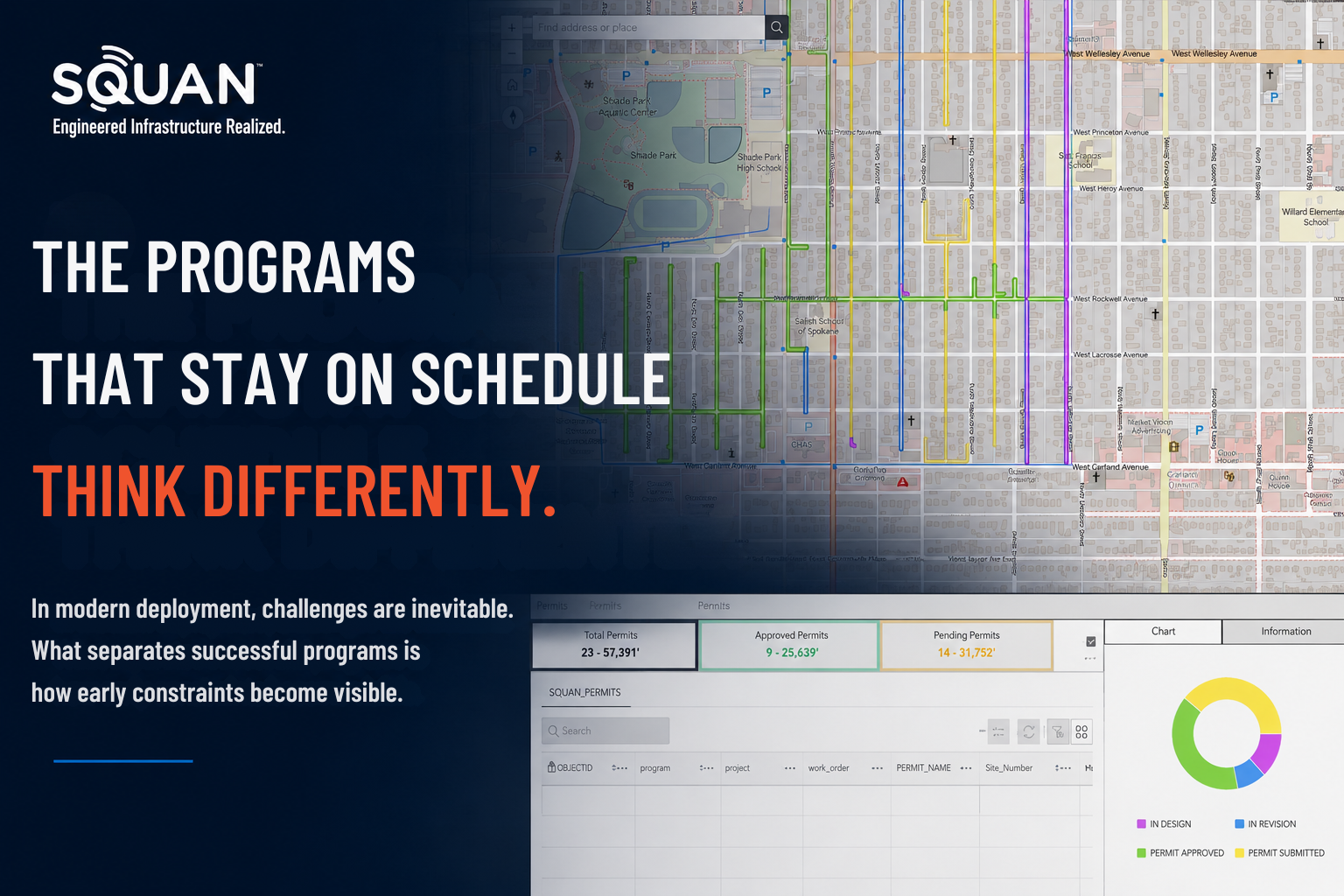
Operating in 22 states and expanding into new markets such as the Pacific Northwest, SQUAN delivers turnkey infrastructure solutions that adapt to policy shifts, scale with demand, and stay ahead of industry change. Our teams provide real-time permitting visibility so customers can track approvals, plan builds effectively, and meet critical deadlines with confidence.

While BEAD funding is not expected to be released until 2026, now is the time to put strategic plans in place. From engineering and permitting to construction and final deployment, SQUAN brings the tools, talent, and foresight to keep broadband projects moving forward.

What is BEAD?
The Broadband Equity, Access, and Deployment Program is a $42 billion federal investment designed to expand high-speed internet access to unserved and underserved communities across the United States. States and territories will distribute these funds to subgrantees who will carry out broadband deployment projects. BEAD is the largest broadband investment in U.S. history.

How SQUAN Supports BEAD-Funded Projects
With decades of experience in telecommunications, utility, and electrical infrastructure, SQUAN has the expertise and nationwide reach to deliver on federally funded projects. Our turnkey capabilities include engineering, fiber and wireless builds, utility and power construction, and technology services for commercial, carrier, and public sector clients.

SQUAN’s safety-first culture, proven track record, and deep industry relationships make us a trusted partner for connecting underserved and unserved communities and for building the networks that power the future.

With over 2.3 million passings designed and counting, SQUAN’s engineering team is making a significant impact on network infrastructure across the United States. From urban centers to rural landscapes, their work spans every type of architecture, geography, and platform, demonstrating a deep understanding of the complexities involved in modern network deployment.

What sets SQUAN apart is its ability to deliver tailored solutions that meet the specific needs of each project. Whether a client requires design-only support or a full turnkey approach, the engineering team provides scalable, efficient designs that help accelerate deployment timelines without compromising quality.

This flexibility ensures that SQUAN’s solutions are not only smart and effective but also future-ready, capable of supporting evolving technologies and growing customer demands.

By combining technical expertise with a client-focused approach, SQUAN continues to build networks that are reliable, scalable, and built for what’s next.