The Financial Reality Behind BEAD Execution
On paper, BEAD represents one of the most significant infrastructure investments the industry has seen.
Funding is allocated.
Awards are announced.
Build plans begin to take shape.
From a distance, it looks like momentum.
But inside active deployment conversations, a different reality is starting to surface.
Because an award is not the same as execution.
The Gap Between Award and Execution
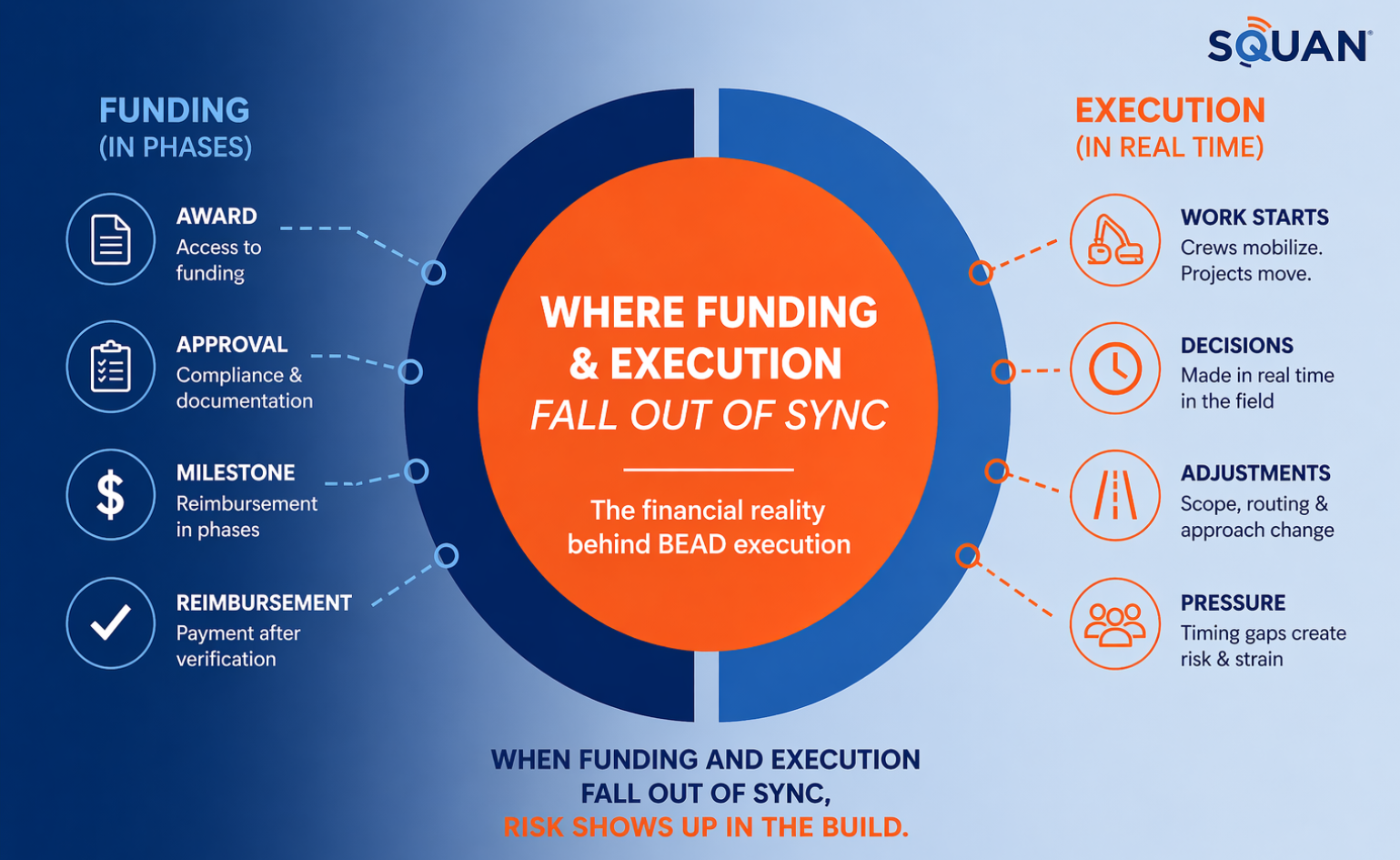
A BEAD award provides access to funding. It does not immediately function as deployable capital.
That funding is tied to:
- Milestone-based reimbursement structures
- Compliance requirements
- Approval timelines
- Documentation and verification processes
Which means the flow of capital does not always align with the pace of construction.
Projects move in real time.
Funding moves in phases.
That gap is where risk begins to build.
Timing Is the Real Constraint
One of the most underestimated challenges in BEAD execution is timing.
Milestone payments often provide funding at the beginning and end of a project, but the middle phases, where the majority of work occurs, require consistent cash flow to maintain progress.
If that gap is not planned for upfront, it creates pressure on both operators and contractors.
And in some cases, it can stall projects that otherwise have full funding behind them.
Because projects don’t fail only due to lack of funding.
They fail when funding and execution fall out of sync.
The Contractor Relationship Is Evolving
Another shift happening under BEAD is the changing dynamic between awardees and contractors.
In traditional builds, pricing and scope often define the relationship.
Under BEAD, that’s no longer enough.
Execution at this scale requires alignment on:
- Working capital expectations
- Cash flow timing
- Risk exposure
- Financial structure throughout the build
When those conversations don’t happen early, contractors can end up absorbing timing gaps that were never intended to be part of the relationship.
And that’s where projects begin to break down.
Financial Decisions Show Up in the Field
These challenges don’t stay in spreadsheets.
They show up in real, physical ways:
- Changes in construction approach
- Adjustments to routing decisions
- Delays in mobilization
- Slowed production in critical phases
What starts as a financial structure decision ultimately impacts how and when networks get built.
Funding Is Part of Execution
It’s often said that funding doesn’t build networks, execution does.
That’s true.
But execution doesn’t operate independently from funding.
Funding structure, timing, and availability are part of execution.
And as BEAD moves from allocation to delivery, the operators who recognize that early will be better positioned to move projects forward without disruption.
Because the challenge ahead is not just deploying capital.
It’s aligning capital with execution.