
Before the First Crew Arrives
Why early infrastructure decisions influence construction costs, project execution, and future expansion in data center environments.
Some of the most consequential decisions in a data center infrastructure project happen before the first construction crew arrives.
Between design approval and mobilization, project teams have an opportunity to evaluate site conditions, confirm infrastructure assumptions, and make decisions that can influence both the current build and future expansion. Once materials are ordered, crews are scheduled, and construction begins, those same decisions become more difficult and potentially more expensive to revisit.
For data center operators, developers, and infrastructure program leaders, this period represents an important opportunity to align engineering decisions with construction realities and long-term infrastructure investment.
When Sound Plans Meet Actual Conditions
Data center operators plan carefully for growth. Campus master plans account for future buildings, network designs anticipate increasing capacity requirements, and infrastructure pathways are often designed to support expansion.
Those plans depend on the information available when they are developed.
Existing utility records may not reflect every modification made during previous construction. Underground pathways may have less available capacity than drawings indicate. Access conditions can change as multiple contractors work across an active campus.
These realities do not necessarily indicate a problem with the original design. They reflect the conditions that engineering and construction teams must account for as infrastructure moves from planning into execution.
Reviewing those conditions before mobilization can reveal opportunities to adjust the approach while the project still has flexibility.
A Pathway Decision With Long-Term Implications
The following scenario is hypothetical.
A data center operator is expanding an existing campus with a new building that requires high-count backbone fiber from the current facility.
The approved design routes the fiber through an existing underground duct bank. According to campus records, several conduits are available, including capacity reserved for future expansion.
During a field review, the team discovers that one of the designated conduits already contains an undocumented cable.
The route remains feasible, but accommodating the new fiber would require using conduit originally reserved for future growth.
At the same time, another contractor is completing underground utility work along a nearby corridor. That construction creates a potential opportunity to install additional telecom conduit while the area is already excavated, subject to engineering requirements, appropriate separation, and owner approval.
The operator now has a decision to make.
Using the available reserve capacity may be the most practical approach for the current project. Adding conduit during ongoing civil work may provide additional flexibility for future expansion.
Both options have implications for infrastructure investment, construction sequencing, and long-term campus capacity.
The important distinction is that the operator can evaluate those implications while the construction opportunity still exists.
Once the excavation is closed and the area restored, adding capacity along that corridor may require a separate construction effort, potentially affecting infrastructure and operations already in place.
How Early Decisions Shape Construction Commitments
The pathway decision also influences the work that follows.
Confirming the route before procurement allows teams to evaluate cable lengths, installation requirements, and the appropriate locations for supporting infrastructure. Testing and acceptance requirements can also be established against the route that will actually be constructed.
These decisions influence material orders, contractor schedules, and the sequence in which work can proceed.
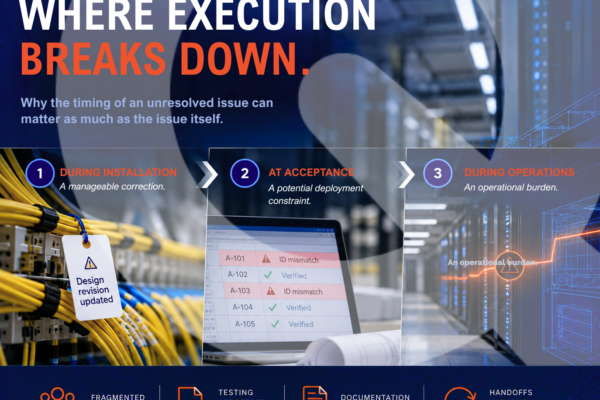
A route adjustment made during planning may require revisions to drawings and estimates. The same adjustment after materials have been purchased and crews mobilized can introduce additional procurement, scheduling, and construction considerations.
For operators managing complex infrastructure programs, the value of early review extends beyond addressing individual site constraints. It provides a more informed basis for committing resources and coordinating the work.
Planning Beyond the Current Deployment
The same considerations apply across different data center environments.
A hyperscaler developing a campus in phases, a neocloud preparing an existing facility for deployment, or a colocation provider expanding capacity within an operating building may face different infrastructure requirements.
Each must make decisions about the physical infrastructure supporting its current and future needs.
Pathway capacity, building entrances, fiber routes, and access requirements can influence how efficiently additional infrastructure is installed later.
Construction sequencing is another consideration. Certain outside plant activities may be ready to proceed while work inside the facility depends on access, equipment installation, or other prerequisites.
Understanding those dependencies before mobilization helps teams establish realistic schedules and deploy construction resources where work can productively advance.
Not every field condition can be confirmed in advance, particularly when underground infrastructure is involved. Identifying which assumptions remain open, however, allows project teams to evaluate alternatives and plan appropriate contingencies.
Bringing Engineering and Construction Perspectives Together
Many decisions made during preconstruction benefit from an understanding of both engineering requirements and field execution.
A proposed fiber route must account for the infrastructure it needs to support, but also the conditions crews will encounter when installing it. Pathway capacity, physical access, installation methods, and construction sequencing can all influence how an approved design is executed.
SQUAN’s experience across engineering and fiber infrastructure construction brings relevant perspectives to these discussions. From route planning and constructability considerations to fiber installation, high-count splicing, and testing, understanding how infrastructure is designed and built can help inform decisions before construction commitments are made.
For operators and developers, that perspective is valuable when evaluating infrastructure requirements against actual site conditions and long-term deployment objectives.
Decisions That Extend Beyond the Build
Every data center environment carries forward the infrastructure decisions made during its development.
The capacity available within underground pathways, the placement of building entrances, and the routes selected for fiber can influence future expansion costs, construction flexibility, and the work required to support additional deployments.
Early planning cannot eliminate every uncertainty that will emerge in the field. It can give operators a clearer understanding of the options available before materials, schedules, and construction activities limit their ability to act.
The decisions made before the first crew arrives can shape the infrastructure a facility depends on for years to come.
For a broader perspective on how infrastructure decisions, execution, and accountability intersect across network and data center environments, read The Accountability Gap: Why Modern Infrastructure Projects Break Down Between Network and Data Center Teams.