What a Passing Test Proves
Why understanding test results matters before infrastructure can be accepted and put into service.
A fiber link passes its loss test. The result meets the specified criteria, the report is generated, and the project moves closer to acceptance.
But a passing result can still leave questions that affect what happens next.
Was the full intended link tested? Were the criteria appropriate for its intended use? Has anything changed since the measurement was taken? And what additional validation is required before the infrastructure can support the next stage of deployment?
These questions matter because infrastructure schedules depend on more than completed installation. They depend on the ability to verify that work meets the applicable requirements and can be accepted by the teams relying on it.
When test evidence leaves important questions unresolved, those questions can become additional investigation, rework or delays at precisely the point when the next phase of execution is expected to begin.
Every Result Has Boundaries
A passing test provides evidence that specific requirements were met under defined conditions. Understanding those conditions is essential to interpreting the result.
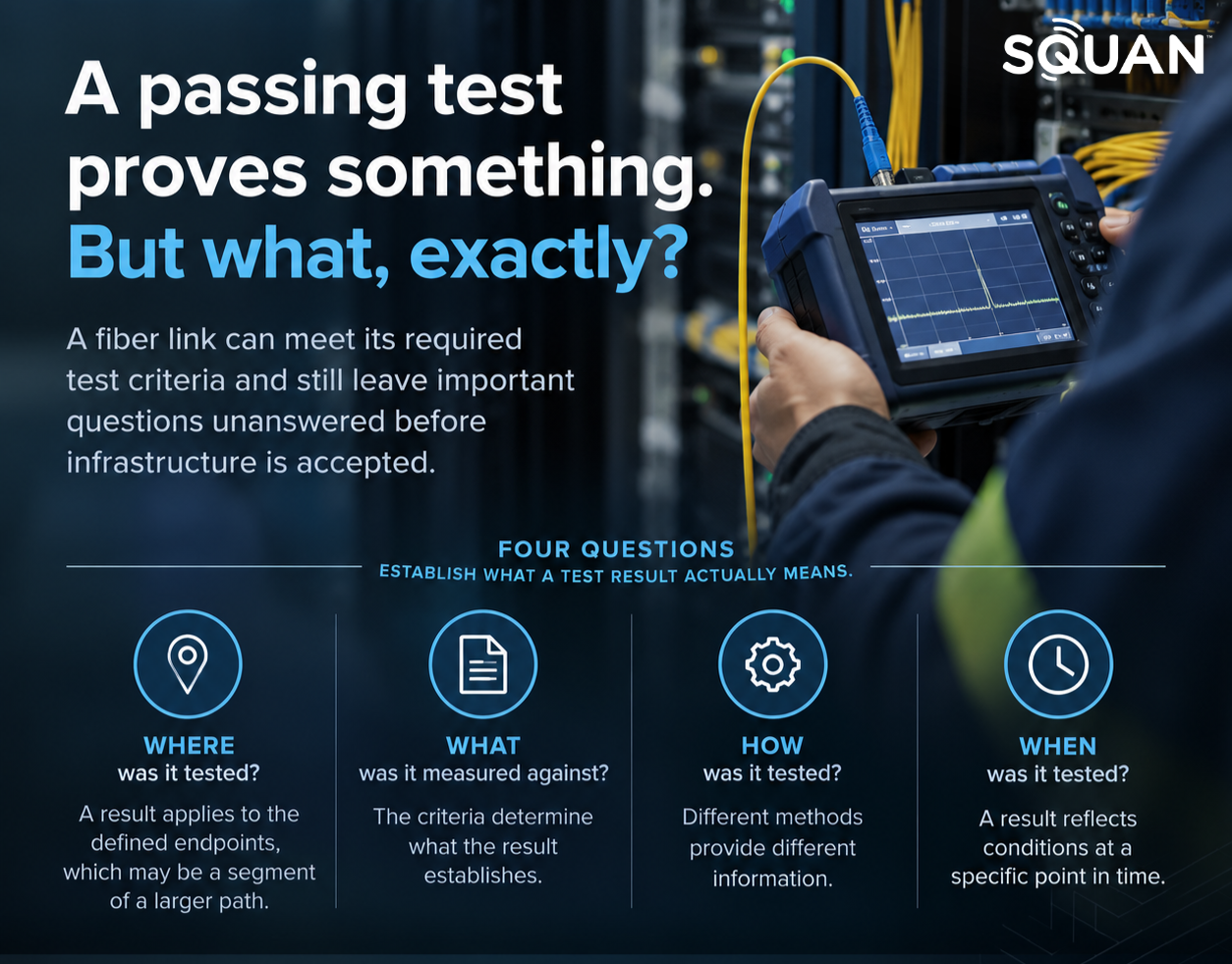
Four questions establish what that evidence actually means.
Where was it tested?
Fiber infrastructure may be tested in segments as work progresses through different parts of a project. A passing result applies to the portion tested, between the defined endpoints.
Understanding those boundaries matters when the receiving team needs to evaluate a larger intended path.
What was it measured against?
A test result only has meaning in relation to its acceptance criteria.
For fiber infrastructure, an optical loss budget may reflect the design, link characteristics and intended application. A result that meets one set of criteria may not necessarily satisfy another.
That is why the applicable requirements must be understood by the teams performing and evaluating the testing.
How was it tested?
Different testing methods provide different information. The method determines which characteristics have been measured and which questions remain outside the result.
When was it tested?
A test captures conditions at a particular point in the project. Subsequent construction, equipment installation or changes to the infrastructure may affect the continued relevance of that result.
These distinctions are important because a passing report can be technically valid while still being insufficient evidence for a broader acceptance decision.
Different Tests Answer Different Questions
Fiber testing offers a practical example of why the method matters.
An optical loss test set (OLTS) measures insertion loss across a defined fiber link, providing a result that can be evaluated against the applicable loss budget.
An optical time-domain reflectometer (OTDR) provides different information about the fiber path, helping identify and characterize events such as splices, connections and potential loss points.
Depending on project requirements, these methods may be used together to provide complementary evidence about the installed infrastructure.
SQUAN’s Data Center Services cornerstone identifies bidirectional OTDR and OLTS testing alongside closeout documentation as part of its fiber infrastructure capabilities.
However, passive fiber testing has defined limits.
It does not, by itself, establish that active equipment has been configured correctly, that a service has been commissioned, or that every supporting system is ready for operation.
Those activities may require separate validation by different technical disciplines.
For the customer, the important distinction is understanding what each result confirms and what additional evidence is necessary before the infrastructure can be accepted for its intended use.
Evidence Has a Timestamp
Testing occurs within an active construction environment. Work does not necessarily stop when a successful result is recorded.
Connections may be accessed, equipment may be installed, and infrastructure may be modified as other activities progress.
Consider a fiber connection that has been inspected, cleaned and successfully tested. If that connection is subsequently handled or changed, the original result documents its earlier condition, but may no longer fully represent the condition being accepted.
Whether additional testing is required depends on the nature of the work and the project’s specifications.
What matters is maintaining visibility into changes that could affect previously validated infrastructure.
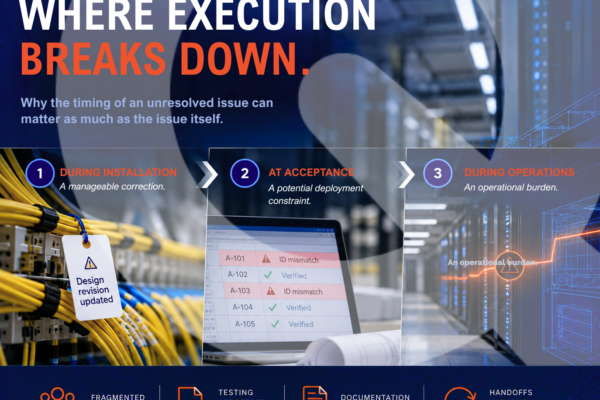
Without that visibility, teams may discover late in the project that additional verification is necessary. The resulting investigation can affect acceptance schedules and delay activities dependent on that infrastructure.
Testing coordinated with the construction sequence helps ensure that the evidence being presented remains relevant to the work being delivered.
Evidence Operations Can Use
The value of test evidence extends beyond the immediate acceptance decision.
A receiving team needs to understand which infrastructure was tested, which requirements were evaluated, and how the results relate to the environment it will operate and maintain.
That means results should be traceable to the links, endpoints and identifiers used in the field.
It also means recognizing the limits of the testing performed.
A collection of passing reports may document successful individual measurements, but those reports are most useful when the receiving team can identify exactly what they establish.
This becomes especially important when troubleshooting is required later.
For example, an OTDR trace recorded during installation may provide a reference for comparing future measurements and investigating changes in fiber performance.
The objective is to create evidence that remains useful after construction is complete.
When test results are clear, traceable and understood, they support better-informed decisions during acceptance and provide a more reliable starting point for ongoing operations.
Testing With Readiness in Mind
For data center owners and operators, the commercial implications are straightforward.
Infrastructure that cannot be accepted may delay the activities that depend on it. Questions about incomplete testing, unclear criteria or outdated evidence can require additional work at a stage when schedules and resources are already committed.
Addressing those questions earlier gives teams a better opportunity to resolve issues before they affect downstream milestones.
This is where disciplined infrastructure execution makes a difference.
SQUAN brings experience in engineering, constructing, splicing and testing fiber infrastructure, where field execution, validation and closeout documentation must support the requirements of the project.
That experience informs how SQUAN approaches infrastructure delivery within the data center ecosystem, with an emphasis on understanding the requirements, executing the work and producing evidence that supports the next stage.
A passing test confirms something specific.
The value comes from understanding what was confirmed, whether the evidence remains applicable, and what additional validation is needed for the intended operational use.
Because the goal is not simply to complete testing. It is to provide the evidence necessary for infrastructure to move forward with confidence.
Explore SQUAN Data Center Services
For a broader perspective on accountability across network and data center infrastructure, read our cornerstone article: