Who Owns the Space Between Scopes?
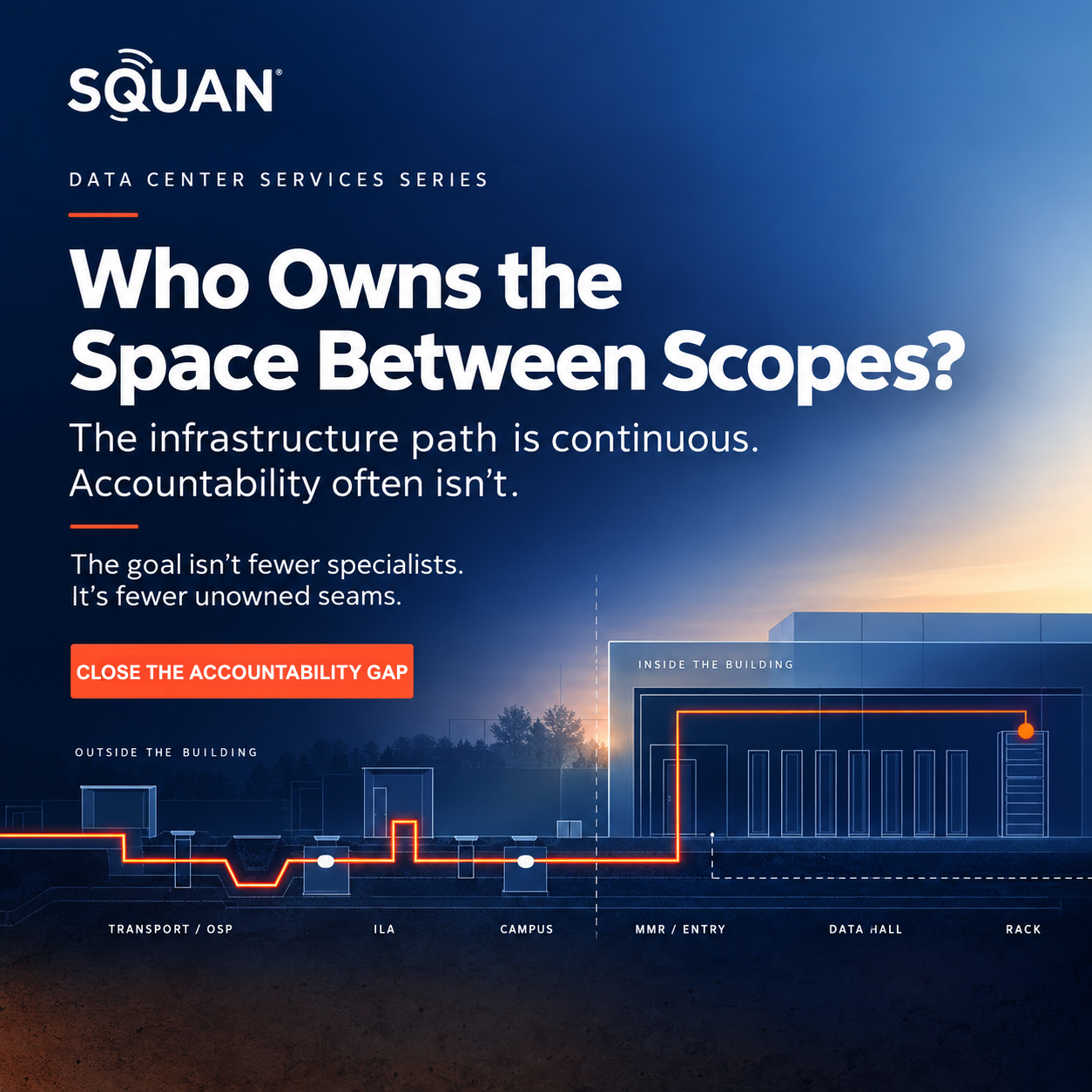
The infrastructure path is continuous. Accountability often isn’t.
In the first installment of our Data Center Services series, we followed the infrastructure path toward the data center and looked at why contractual boundaries don’t change how the complete environment ultimately has to perform.
That leads to another question:
Everyone owns a scope. Who owns the space between them?
The accountability gap doesn’t necessarily begin when work changes hands. It can form much earlier, wherever two scopes depend on the same requirement, assumption, piece of information or infrastructure.
A design assumption made upstream can affect construction downstream. A pathway decision can affect what needs to move through it. Requirements established by one team can become dependencies for another. Documentation developed independently can describe different versions of the same environment.
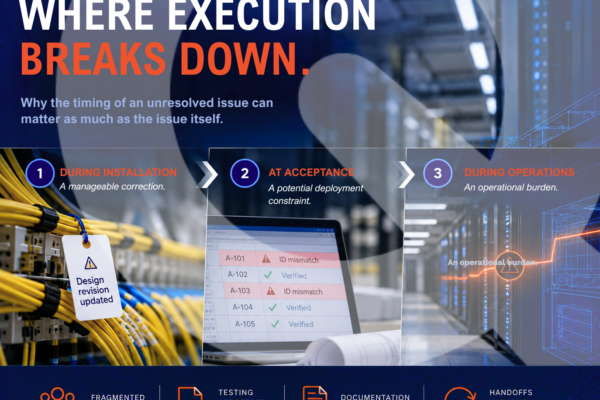
By the time those differences become visible in the field, teams may already be resolving ownership, reconciling records, retesting work or correcting assumptions that could have been addressed earlier.
The goal isn’t fewer specialists. It’s fewer unowned seams.
The Gap Lives Between the Work
How responsibilities are divided across a data center project can vary by customer, project and deployment model.
What doesn’t change is the need for requirements, information and performance expectations to carry across those boundaries.
Sometimes the problem isn’t a failed scope. It’s two pieces of completed work that don’t align.
The infrastructure doesn’t care where one contract ended and another began. It still has to work.
Testing Has to Prove More Than Individual Scopes
Individual providers can install, test and document the work within their respective scopes. Those results matter. Operational readiness also depends on what happens when those individually validated pieces are expected to function together.
Validation has to support the service path and the environment operations will ultimately inherit. That requires clarity around where one team’s validation ends, what the next team receives and how the environment is accepted before handoff.
When those gaps aren’t identified before turnover, problems that should have been caught earlier can surface during operations, when commitments, capacity and schedules are already on the line.
Testing is more than evidence of completed work. It’s part of establishing readiness.
Accurate Records Still Have to Describe the Same Environment
Documentation creates another point of risk.
An as-built can be accurate. A splice record can be accurate. An MMR assignment or rack label can each be documented correctly.
But individual accuracy isn’t enough if those records don’t reconcile across the environment.
When documentation is created and maintained across different scopes, the information has to carry forward consistently. Otherwise, operations inherits the work of determining which record reflects what was actually built.
Good documentation establishes the baseline teams depend on for testing, troubleshooting, maintenance and future changes.
Accountability Doesn’t Replace Specialization
Closing the accountability gap doesn’t mean eliminating specialized partners.
Specialists can own the work. Someone still has to own the interfaces.
That means maintaining continuity as requirements move between teams, keeping information consistent, understanding dependencies before they become field problems and making sure acceptance criteria are clear and agreed before operational handoff.
Interface ownership shouldn’t add another layer between the teams doing the work. It should create accountability across the work itself, reducing unnecessary handoffs where scopes can be self-performed together and maintaining clear ownership where qualified partners are involved.
Handoff Should Transfer a Verified Environment
A strong handoff gives the next team confidence in what they’re receiving.
The required testing has been completed. Documentation reflects the installed environment. Known issues have been resolved or clearly identified. And the information operations needs doesn’t disappear when project ownership changes.
Handoff has to transfer more than completed work. It has to transfer a verified environment.
Closing the Accountability Gap
This is where SQUAN’s execution model matters.
Across the infrastructure lifecycle, SQUAN can self-perform critical work, coordinate across disciplines and manage qualified partners where required. That creates the opportunity to reduce handoffs where possible and maintain accountability across the interfaces that remain.
Testing, documentation and operational handoff are part of that execution, because the objective isn’t simply to finish individual scopes. It’s to deliver infrastructure that the next team can confidently inherit and operate.
The spaces between scopes shouldn’t be left unowned.
Build With Accountability Beyond the Scope
See how SQUAN approaches accountable infrastructure execution from deployment through operational handoff.