
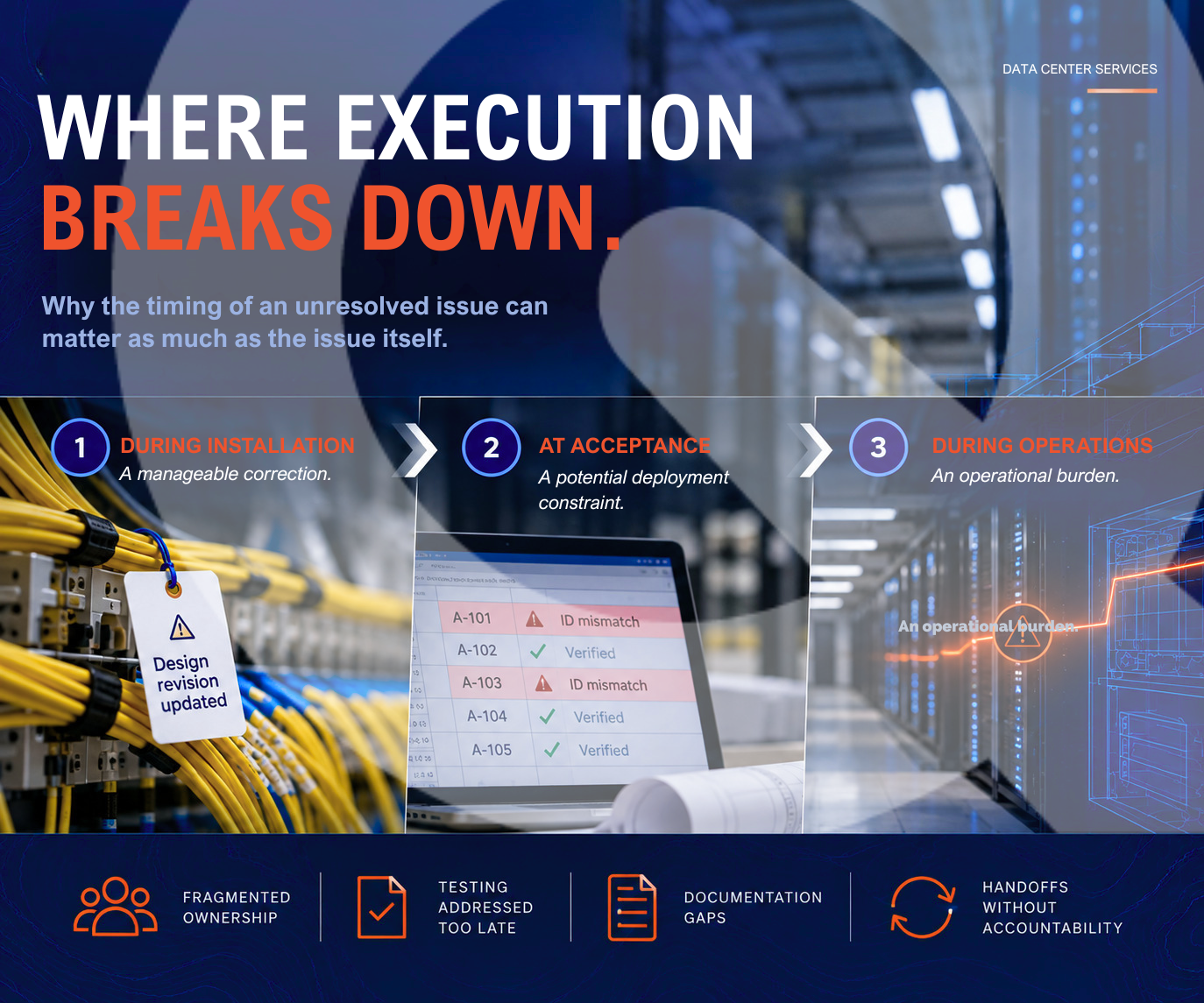
Where Execution Breaks Down
Why the timing of an unresolved issue can matter as much as the issue itself.
A data center infrastructure project can meet its construction milestones while the risk to its next deployment milestone continues to grow.
Installation progresses. Fiber is spliced and tested. Individual scopes move toward completion. Yet a discrepancy identified during construction may remain unresolved because it has not prevented the work currently underway.
The consequences become more significant when another team needs to accept, activate, or maintain the infrastructure.
At that point, a question that could have been addressed during installation may require additional investigation, coordination across contractors, or changes to planned activities.
This is one of the more consequential challenges in complex infrastructure delivery: the impact of an unresolved dependency often depends on when it is discovered and what must happen next.
One Discrepancy, Three Different Consequences
Consider a hypothetical campus fiber deployment where a design revision changes several fiber assignments.
The installation proceeds according to the revised design, but the change is not consistently reflected in the splice records, panel identifiers, and associated test documentation.
The physical infrastructure may be correctly installed. The completed test results may also be valid. However, the receiving team still needs reliable information linking the installed infrastructure to the evidence supporting its acceptance.
How that discrepancy affects the project depends largely on when it is identified.
During Installation: An Opportunity to Reconcile
If the inconsistency is discovered while the relevant construction work is active, the project team may be able to compare the revised design, field records, and installed assignments before closeout.
The discrepancy still requires attention, but the personnel and information needed to resolve it may be readily available.
At this stage, the question is relatively contained: Do the records accurately describe what was installed, and can the existing test evidence be traced to the correct links?
Addressing that question during execution can reduce the amount of reconstruction required later.
At Acceptance: A Dependency on the Next Team
Now consider the same discrepancy being identified when the receiving team reviews the turnover package.
The installation may be complete, but the receiving team needs to establish whether the documentation and test evidence satisfy the agreed acceptance requirements.
Resolving the issue could involve engineering, construction, testing personnel, and the receiving party. Existing records may be sufficient once reconciled, or additional verification may be warranted.
The underlying discrepancy has not necessarily changed.
What has changed is its position in the project schedule.
The receiving team may have resources committed, subsequent activities planned, and dependencies that cannot be resolved until the acceptance question is answered.
A records issue has become a potential deployment constraint.
During Operations: An Inherited Problem
If the inconsistency is not identified or resolved before turnover, its consequences may surface later.
An operations team investigating a fiber fault or planning a network change relies on accurate identification of the installed infrastructure.
When panel assignments, splice records, and test documentation do not reconcile, troubleshooting may require additional effort to establish the actual configuration before corrective work can proceed.
The issue that began as an incomplete documentation update has now become an operational burden.
Across all three stages, the technical discrepancy may be similar. The consequences differ because the infrastructure is supporting different activities, responsibilities, and commitments.
How Four Execution Risks Become One Problem
This progression illustrates the four failure points identified in SQUAN’s broader examination of infrastructure accountability.
Fragmented ownership. When a discrepancy involves engineering changes, field installation, and receiving-party requirements, responsibility for coordinating its resolution must be clear. Otherwise, each team may be waiting for a decision outside its immediate scope.
Testing addressed too late. Testing may have been completed correctly, but acceptance can still require clarification about which infrastructure was tested, whether the evidence corresponds to the installed configuration, and whether it satisfies the agreed requirements.
Documentation gaps. Records maintained independently can fall out of alignment as field conditions and designs change. Without consistent updates, the project loses an important connection between the infrastructure installed and the information used to validate and maintain it.
Handoffs without accountability. A turnover package can contain completed deliverables while leaving unresolved questions about acceptance, outstanding corrective work, or responsibility for the next action.
These risks are interconnected.
An inconsistent record can create a validation question. Resolving that question may require coordination between multiple scopes. If responsibility remains unclear, the issue can persist until the receiving team needs an answer.
The greatest disruption may occur well after the original discrepancy was introduced.
What Project Progress Does Not Always Reveal
Traditional construction milestones provide necessary information about work completed. They do not always show whether outstanding dependencies are becoming more consequential as the project advances.
A fiber installation can be substantially complete while its closeout documentation still requires reconciliation. Testing can be finished while the receiving team is awaiting clarification of the applicable evidence. Individual contractors can meet their assigned deliverables while an interface issue remains open.
That makes the status of unresolved dependencies an important part of understanding project readiness.
For operators and infrastructure program leaders, the practical questions are:
- Which issues remain open, and what downstream activities depend on their resolution?
- Who is responsible for making the necessary decisions across the affected scopes?
- What evidence is required for the receiving team to accept the work?
- Can the issue be addressed during active construction, before it affects a later milestone?
These questions help distinguish work that is progressing from work that is ready to support the next phase.
They also give project teams an opportunity to address problems when the necessary people, information, and resources are more readily available.
The Value of Engineering and Field Execution Working Together
Preventing every field discrepancy is unrealistic. Managing the consequences requires an understanding of how engineering decisions, construction activity, validation requirements, and closeout information affect one another.
That is where SQUAN’s infrastructure experience is relevant.
SQUAN supports data center infrastructure through engineering, outside plant and campus fiber construction, high-count splicing, fiber testing and certification, and infrastructure build capabilities.
These services address related stages of infrastructure delivery, where changes made during construction can influence testing requirements, documentation, and the information needed for acceptance.
When multiple related scopes are delivered together, there may be opportunities to reduce the number of interfaces requiring coordination. Where responsibilities are shared with other contractors or technical disciplines, clearly defined requirements and ownership remain essential.
For customers, the value lies in understanding those dependencies while decisions can still be made within the active project, rather than discovering their consequences when the next phase is waiting.
SQUAN’s role is to support disciplined execution and validation within its agreed scope, while helping ensure that the work it delivers can be understood and evaluated by the teams receiving it.
The Question That Matters Before the Next Milestone
Execution challenges rarely begin at the moment they disrupt a schedule.
They often begin earlier, when a change is made, an assumption remains unverified, or an unresolved issue moves forward with the project.
The question for infrastructure teams is not simply whether the current phase is on schedule.
It is whether the next phase has what it needs to proceed, and whether the remaining dependencies have clear owners before they become obstacles.
For data center operators managing increasingly demanding deployment schedules, recognizing that distinction early can help prevent manageable issues from becoming larger constraints on infrastructure readiness.
Understand the Infrastructure Behind Readiness
Explore how SQUAN supports data center infrastructure through engineering, fiber construction, splicing, testing, and infrastructure build services.
For the broader perspective on accountability across network and data center infrastructure, read The Accountability Gap: Why Modern Infrastructure Projects Break Down Between Network and Data Center Teams.