The Structural Gap in BEAD Execution: Who Will Carry the Work Before Funding Arrives
On paper, BEAD represents one of the most significant infrastructure investments the industry has seen.
Funding will be allocated.
Awards will be announced.
Build plans will begin to take shape.
From a distance, it will look like momentum.
But as the industry moves from allocation toward execution, another layer is likely to come into focus.
It won’t just be about how much funding is available.
It will be about how that funding actually shows up during a build.
An Award Won’t Mean Cash in Hand
One of the most common assumptions heading into programs like BEAD is that an award equals accessible capital.
It doesn’t.
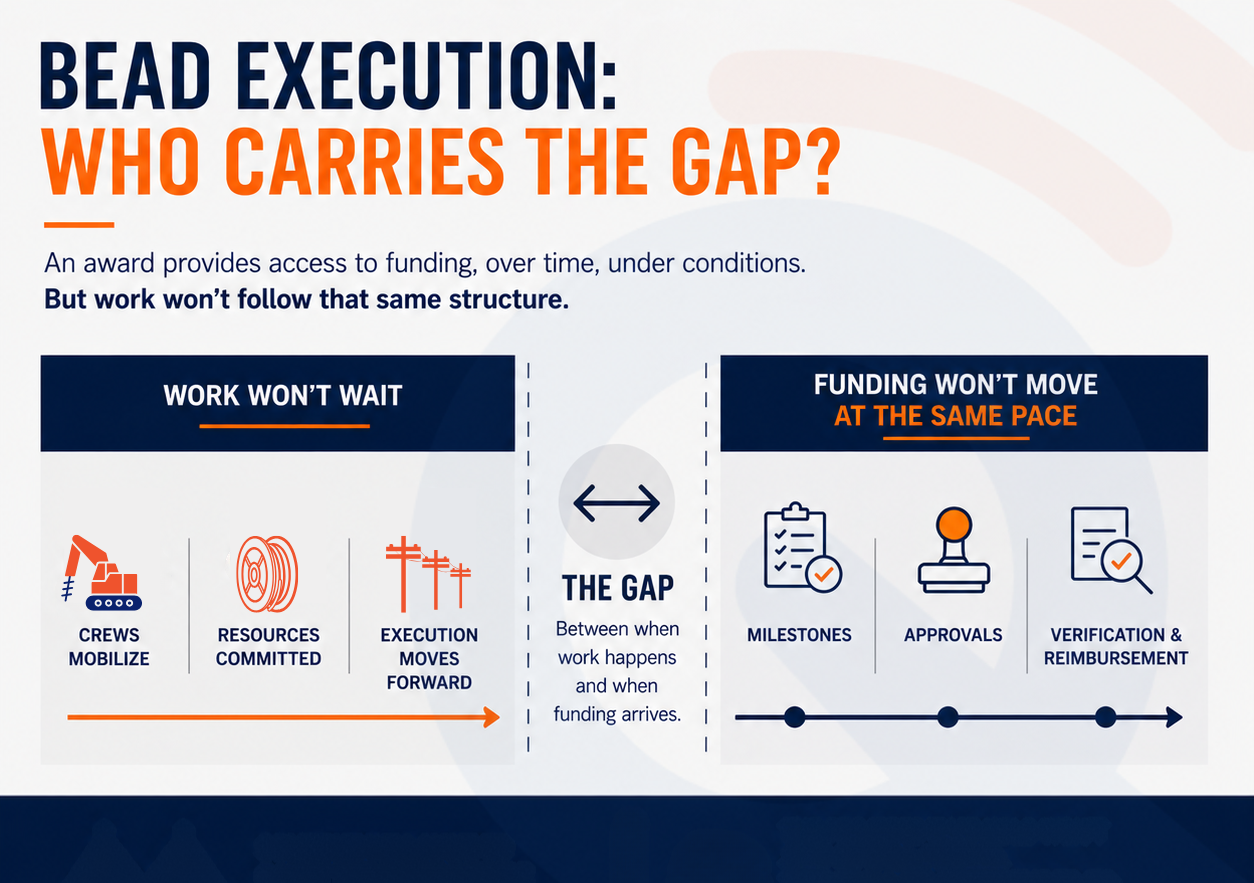
An award will provide access to funding.
That funding will be released over time.
And it will be tied to conditions.
Milestones.
Approvals.
Documentation.
Verification.
Which means funding won’t move at the same pace as construction.
And based on previous government programs, that difference is where pressure tends to build.
Work Will Move Continuously. Funding Will Not.
Construction doesn’t wait.
Crews will mobilize.
Materials will be ordered.
Projects will move forward in real time.
But funding will follow a different path.
It will arrive in phases.
Often at the beginning.
Often at the end.
And more selectively through the middle.
That creates a gap between when work happens and when funding is received.
Early on, that gap may feel manageable.
At scale, it becomes harder to absorb.
The Gap Will Have to Be Carried
When funding and execution don’t align, the impact won’t stay in financial models.
It will show up in how projects are carried.
Because someone will have to bridge that gap.
Working capital won’t appear automatically.
Cash flow won’t smooth itself out.
And reimbursement timelines won’t adjust to field conditions.
That leads to a critical question:
Who will carry the project between milestones?
In many cases, that won’t be fully defined upfront.
And that’s where risk is likely to build.
Where Execution Pressure Is Likely to Show Up
If funding structure doesn’t align with how work progresses, the effects will be visible:
- Projects may become harder to sustain at full pace
- Decisions may compress under financial pressure
- Risk may shift between operators and contractors
- Execution may start to move differently than planned
Not because anything is broken.
But because the system supporting execution wasn’t designed around how execution actually works.
Why This Will Matter More in BEAD
The industry has seen versions of this dynamic before.
But BEAD introduces additional variables that will likely amplify the impact:
- Larger funding allocations
- A broader range of awardee profiles
- Increased compliance requirements
- More defined milestone structures
- Greater pressure to deploy at scale
For some participants, this may be their first time managing programs at this level of complexity.
Which makes the structure behind funding even more important.
Execution Won’t Be Just Operational. It Will Be Financial.
There’s a common industry phrase: funding doesn’t build networks, execution does.
That will remain true.
But execution won’t operate independently from funding.
It will depend on it.
Not just in total dollars, but in timing, structure, and accessibility.
Execution is where engineering, construction, and capital meet in real time.
If one of those elements falls out of alignment, the impact will be immediate.
What Stronger Structures Will Require
The projects that move successfully won’t just be well-funded.
They will be structured to support execution from start to finish.
That will require:
- Understanding how cash flows through the full lifecycle of a project
- Planning for the middle phases, not just the start and finish
- Aligning funding expectations with real-world build timelines
- Defining how working capital is managed across stakeholders
- Treating financial structure as part of execution, not separate from it
Because at scale, structure will determine stability.
As BEAD moves closer to deployment, the conversation will continue to evolve.
From how much funding is available
To how that funding supports execution
The difference between those two is where projects will either hold or begin to drift.
For teams planning ahead, aligning funding structure with execution early may be one of the most important decisions made before construction begins.