The Network Has a Place on the Construction Schedule
Why coordinating fiber infrastructure early matters for large-scale data center development.
A data center campus can be approaching a major construction milestone while the network infrastructure needed to support it is still moving through an entirely different schedule.
The building may be taking shape. Electrical and mechanical systems may be progressing toward commissioning. Equipment installation may already be planned.
Meanwhile, the fiber route serving the campus could still be awaiting permits, the building entry pathway may not be ready for cable placement, or the final connections may still require splicing and testing.
For general contractors and EPC teams responsible for delivering complex data center developments, these are construction dependencies with consequences for the broader project.
As data center campuses grow in scale, the physical infrastructure connecting them to regional networks becomes an increasingly important part of construction planning.
The question is whether that infrastructure is being coordinated with the same attention given to the other critical components of the build.
Network Infrastructure Has Its Own Construction Sequence
Fiber connectivity is often viewed as a requirement for the completed facility. Delivering that connectivity, however, involves an extensive sequence of engineering, permitting, construction, and validation activities.
Depending on the project, that work can include outside fiber routes, campus duct banks and pathways, building entrances, meet-me room connectivity, high-count splicing, and acceptance testing.
Each activity introduces dependencies that must align with the larger construction program.
Route engineering and permitting can influence when outside plant construction begins. Campus pathways must be coordinated with civil work and site access. Building entry locations must align with the physical network design. Cable placement, splicing, and testing must be sequenced to support the required acceptance milestones.
These requirements become even more important when a campus is being delivered in phases.
A network connection supporting the first operational building may need to be ready while construction continues elsewhere on the property. That creates additional considerations for access, work sequencing, and coordination between contractors.
For construction managers, understanding these dependencies early helps establish a more realistic path from infrastructure installation to acceptance.
Where Construction Packages Intersect
Large data center programs depend on specialized teams working across multiple construction disciplines.
Civil contractors may be responsible for portions of the underground pathway infrastructure. Fiber construction teams may deliver outside plant routes and campus connections. Other specialists may handle building entry, internal cabling, splicing, or testing.
In some programs, these scopes are managed through the general contractor or EPC organization. In others, certain network components are contracted directly by the owner or carrier.
The contracting structure may differ, but the physical infrastructure still needs to connect.
Consider a campus where the outside fiber route is ready for cable placement, but the building entrance has not yet been released for installation.
The outside plant contractor may be progressing according to schedule. The building contractor may also be meeting its own milestones. Yet the connection between their scopes remains unavailable.
The same challenge can occur when cable installation is complete but fiber assignments, testing requirements, or acceptance documentation have not been aligned with the team receiving the infrastructure.
Individual construction packages can reach completion without establishing readiness across the connected network.
These are the interfaces where clear responsibilities and coordinated execution become especially important.
What Construction Teams Should Expect From an Infrastructure Partner
For general contractors and EPC teams, specialized infrastructure partners play an important role in identifying and managing network-related dependencies.
That value begins before construction crews arrive.
An experienced infrastructure partner should be able to evaluate how the assigned scope interfaces with surrounding work, identify access and sequencing requirements, and establish what must be completed before the next activity can proceed.
Several questions deserve attention during planning.
Who owns the pathway between the property boundary and the building? Which team is responsible for cable placement and splicing? When will the required areas be accessible? What testing must be completed before the infrastructure can be accepted? Which records will be delivered at closeout?
The answers help define more than individual responsibilities. They establish the working relationships between the construction packages.
Field execution also requires consistent communication as conditions change.
A revised building entrance location, delayed pathway release, or change in the construction sequence can affect work that is already engineered or scheduled.
When infrastructure partners understand the broader construction environment, they are better positioned to identify those impacts and coordinate the necessary adjustments.
The objective is to make network requirements visible within the construction plan while there is still time to address them.
Construction Coordination and the Accountability Gap
In SQUAN’s cornerstone article, The Accountability Gap: Why Modern Infrastructure Projects Break Down Between Network and Data Center Teams, we examine the challenges that arise when specialized teams manage connected infrastructure through separate responsibilities, requirements, and handoffs.
The same underlying issue can begin during construction.
A completed installation does not necessarily establish that the infrastructure is ready for the next phase of deployment.
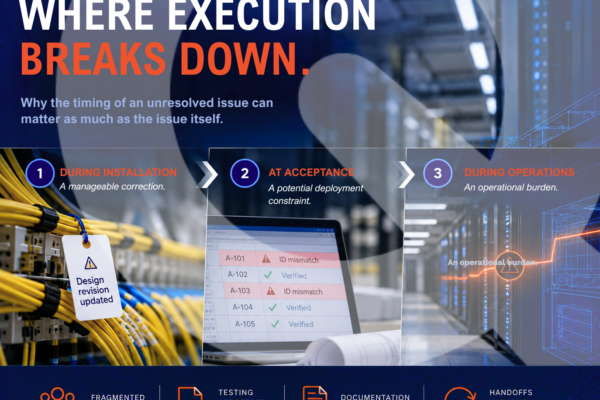
Testing must confirm that the installed network meets the project’s technical requirements. Documentation must accurately reflect the physical environment. Outstanding exceptions must be identified, assigned, and resolved according to the agreed acceptance process.
When these expectations are established late, construction teams may discover that an apparently completed scope still requires additional work before it can be accepted.
Addressing readiness requirements earlier creates a clearer connection between construction milestones and operational expectations.
For EPC teams and general contractors, that means looking beyond whether individual trade packages have finished their assigned activities and understanding what is required for the connected infrastructure to be ready.
Where SQUAN Fits
SQUAN brings established Engineering and Wireline Construction capabilities together with its Data Center Services offering to support the physical infrastructure requirements of complex projects.
Our capabilities include route engineering and permitting, fiber construction, campus and building-entry connectivity, high-count splicing, testing, and infrastructure documentation.
Depending on the project requirements, SQUAN can self-perform defined scopes, coordinate execution across its divisions, or manage qualified partners.
This approach creates opportunities to support general contractors, EPC organizations, developers, and network operators with specialized infrastructure work that must align with broader construction programs.
SQUAN’s role is grounded in understanding how the work is engineered, constructed, tested, and prepared for turnover.
For construction partners, that means engaging an infrastructure organization that recognizes the relationship between physical network delivery and the milestones surrounding it.
Bringing Network Readiness Into the Build Plan
As data center developments expand, the network infrastructure supporting them will continue to cross multiple work packages, construction disciplines, and organizational boundaries.
The most effective time to address those interfaces is before they become constraints on the schedule.
Clear scope definitions, early coordination, realistic construction sequencing, and established acceptance requirements give project teams a stronger foundation for delivery.
For general contractors and EPC teams, incorporating network infrastructure expertise into the construction planning process can help align specialized work with the larger program.
The goal is a connected infrastructure environment that meets the project’s requirements when it is needed.
SQUAN supports the engineering, construction, connectivity, and validation work behind critical infrastructure development.
Explore our cornerstone article, The Accountability Gap: Why Modern Infrastructure Projects Break Down Between Network and Data Center Teams, to learn more about why coordinated execution matters from outside plant through operational readiness.