The Data Center Environment Doesn’t Start at the Building
Why data center readiness depends on the infrastructure path long before it reaches the facility.
A data center project can begin hundreds of miles before the property line.
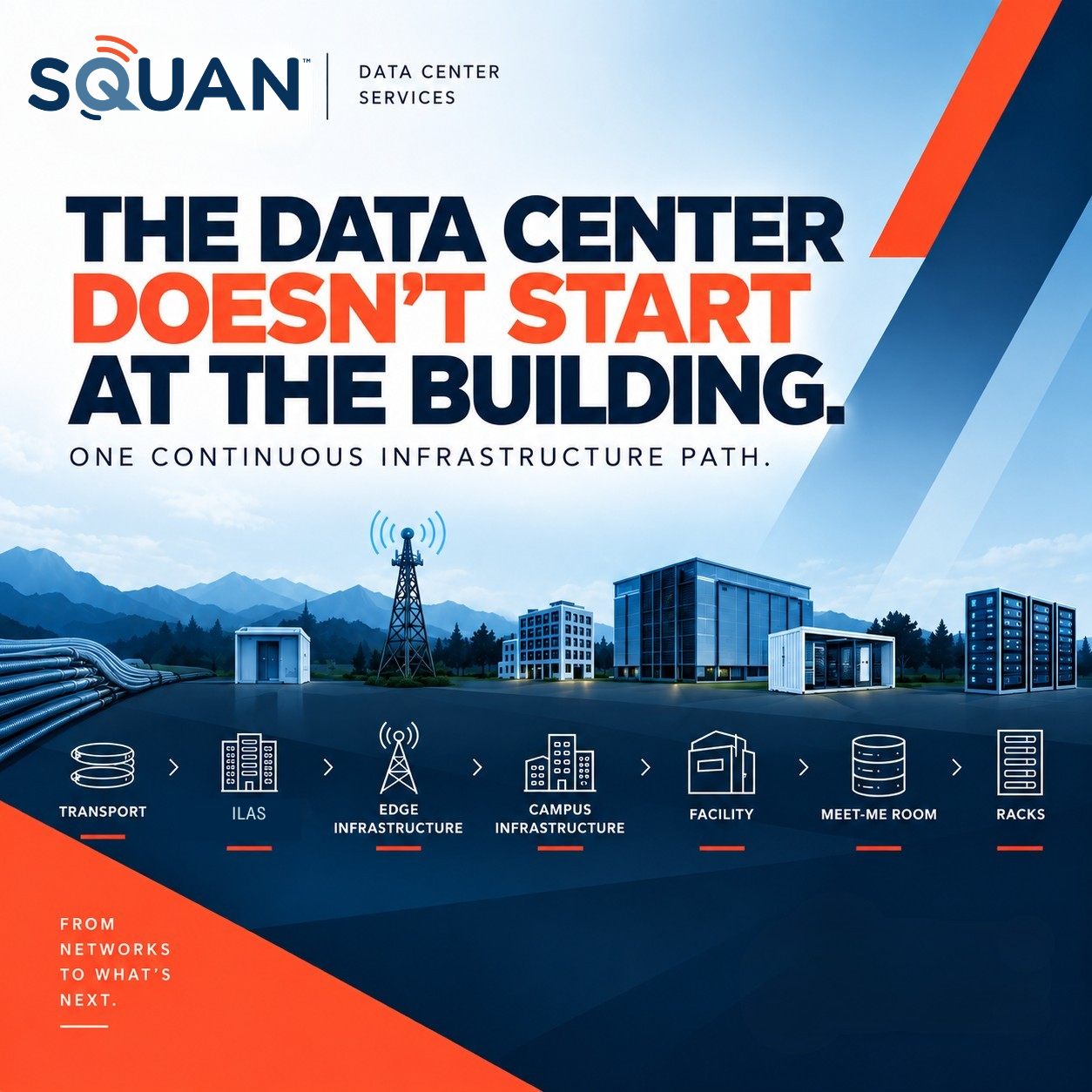
The route may move through fiber builds or ILAs before reaching a campus. From there, infrastructure continues through the site, into the facility, through the meet-me room and ultimately toward the racks supporting compute.
Contracts may divide that journey into separate scopes. Operationally, the infrastructure does not.
That distinction is becoming increasingly important as AI and hyperscale environments place greater demands on the infrastructure required to bring capacity online. Purchased compute is only useful when the environment supporting it is operationally ready, and that environment extends well beyond the walls of the data center. The path includes fiber, edge infrastructure, power, facility infrastructure, rack-level connections, testing and operations.
The data center may be the destination. Readiness starts long before the building.
Follow the Infrastructure Path
Consider what it takes to carry capacity from a long-haul network into a data center environment.
Along the route, ILAs may support the transport network. Backbone fiber has to be engineered, constructed spliced and tested. The route eventually reaches the campus, crosses into facility infrastructure, enters the meet-me room and continues toward the equipment it was built to support.
The SQUAN Data Center Services cornerstone maps this as a continuous path, spanning fiber, ILAs, edge infrastructure, utility and power, facility construction, rack and MMR infrastructure, testing and commissioning, and ultimately Day 2 operations.
Yet the organizations responsible for those pieces can change several times along the way.
An outside plant contractor may bring infrastructure to the perimeter or just inside the property. Another team extends it into the facility. Other specialists may be responsible for the work inside.
Those boundaries are real from a contracting and organizational standpoint.
They are not boundaries for the infrastructure itself.
Traffic does not stop at a scope boundary. Neither does the performance requirement.
Where One Scope Ends, the Path Keeps Going
Specialization is not the problem. Modern infrastructure requires specialized expertise.
The challenge is maintaining continuity as the work moves between those specialties.
Each team may execute its assigned scope correctly while the complete path still depends on what happens at the handoff. A fiber segment can be installed and tested. Facility infrastructure can be built. Rack-level work can be completed. Each individual deliverable can meet its requirements.
But the infrastructure ultimately has to perform as one system.
This is why the points between scopes deserve as much attention as the scopes themselves.
Who owns the transition from the outside network into the facility? Are the assumptions on both sides of the handoff aligned? Does the documentation follow the infrastructure as ownership changes? Has validation occurred only within individual scopes, or across the path those scopes collectively support?
Those questions become increasingly consequential as infrastructure scales.
SQUAN’s cornerstone points to fiber quantities reaching 864, 1728 and beyond , along with ribbon and mass-fusion splicing and reduced-form-factor fiber for increasingly constrained pathways and cabinets. As fiber counts climb while physical space remains limited, the margin for errors such as a mislabeled cassette or a missed loss-budget check becomes smaller.
Complexity does not disappear because responsibility changes hands.
Complete Is Not Always Ready
This leads to an important distinction.
A scope can be complete without the entire infrastructure path being ready.
That does not necessarily mean someone failed. It means scope completion and operational readiness answer two different questions.
Scope completion asks: Was the assigned work delivered?
Operational readiness asks: Does the complete environment function as intended?
That second question reaches across contractual boundaries.
Testing provides a clear example. When validation follows individual vendor scopes rather than the full service path, every segment can pass independently while the complete environment remains unverified. That issue may not become visible until turn-up, when the infrastructure is expected to function as a system rather than a collection of individual projects.
This is where the conversation begins to move beyond individual scopes and toward accountability for the outcome.
Continuity Matters More Than Consolidation
Creating continuity across the infrastructure path does not mean expecting one organization to be the best at every specialized discipline.
Data center infrastructure is an ecosystem, and specialization will remain part of it.
What matters is whether the execution model maintains visibility, standards and accountability as work moves between those specialists.
That requires understanding what happens before and after an individual scope. It requires handoffs that transfer more than responsibility. They must also transfer accurate information, validated infrastructure and a clear understanding of what comes next.
For owners and operators, that creates a different way to evaluate progress.
Instead of looking only at whether individual scopes are closing, the focus expands to whether those scopes are collectively moving the environment toward readiness.
Bringing Infrastructure Experience Into the Data Center
SQUAN’s perspective on this challenge begins with the infrastructure outside the facility.
Engineering, permitting, fiber construction, power infrastructure and critical network deployment have long required coordination across jurisdictions, physical assets, field teams and handoffs. The work may change as the infrastructure moves toward and into the data center, but the need for disciplined execution does not.
SQUAN is bringing that same execution expertise into Data Center Services (DCS), supporting infrastructure across the path from network and site development through deployment, testing and operational support. SQUAN’s DCS model combines engineering, construction, infrastructure and operational capabilities around the objective of delivering environments that are built, validated, documented and ready to perform.
Because the infrastructure does not become interconnected when it reaches the building.
It was interconnected all along.
And as infrastructure requirements continue to scale, understanding that complete path is becoming increasingly important to getting from design to operational readiness.
The Next Question: Who Owns the Gaps?
Following the infrastructure path reveals something important: some of the greatest execution risk exists where one scope ends and another begins.
That is the accountability gap.
In our Data Center Services cornerstone, SQUAN explores how those gaps form, where they put projects at risk and what stronger execution models do differently.